By the Central Mechanical Services LLC team
Licensed Phoenix mechanical contractor - AZ ROC #325571 & #325622
In this article (8 sections)
- 01First 5 minutes: safe checks before you call anyone
- 02Why Phoenix AC units stop cooling above 110 degrees
- 03The 6 most common causes we see on Valley service calls
- 04Frozen coil, dirty filter, low refrigerant: how to tell them apart
- 05What AC repair in Phoenix actually costs in 2026
- 06When it is an emergency: shut it off now vs wait until morning
- 07Repair vs replace: the honest math for a 10+ year old unit
- 08Where to go next
It is 112 degrees outside, the thermostat says 82, and the air coming out of your vents feels lukewarm. This is the single most common call our dispatch line takes from June through September, and most of the time the fix is smaller than homeowners fear.
This guide walks through what to check in the first five minutes, why Phoenix AC units struggle above 110 degrees even when nothing is broken, the six failures our techs see most on Valley service calls, what repair actually costs in 2026, and the honest signals that mean it is time to stop running the unit and call for help. Written by the field techs at Central Mechanical Services who run these calls every week.
First 5 minutes: safe checks before you call anyone
Do these in order. Every one of them is safe with the system running.
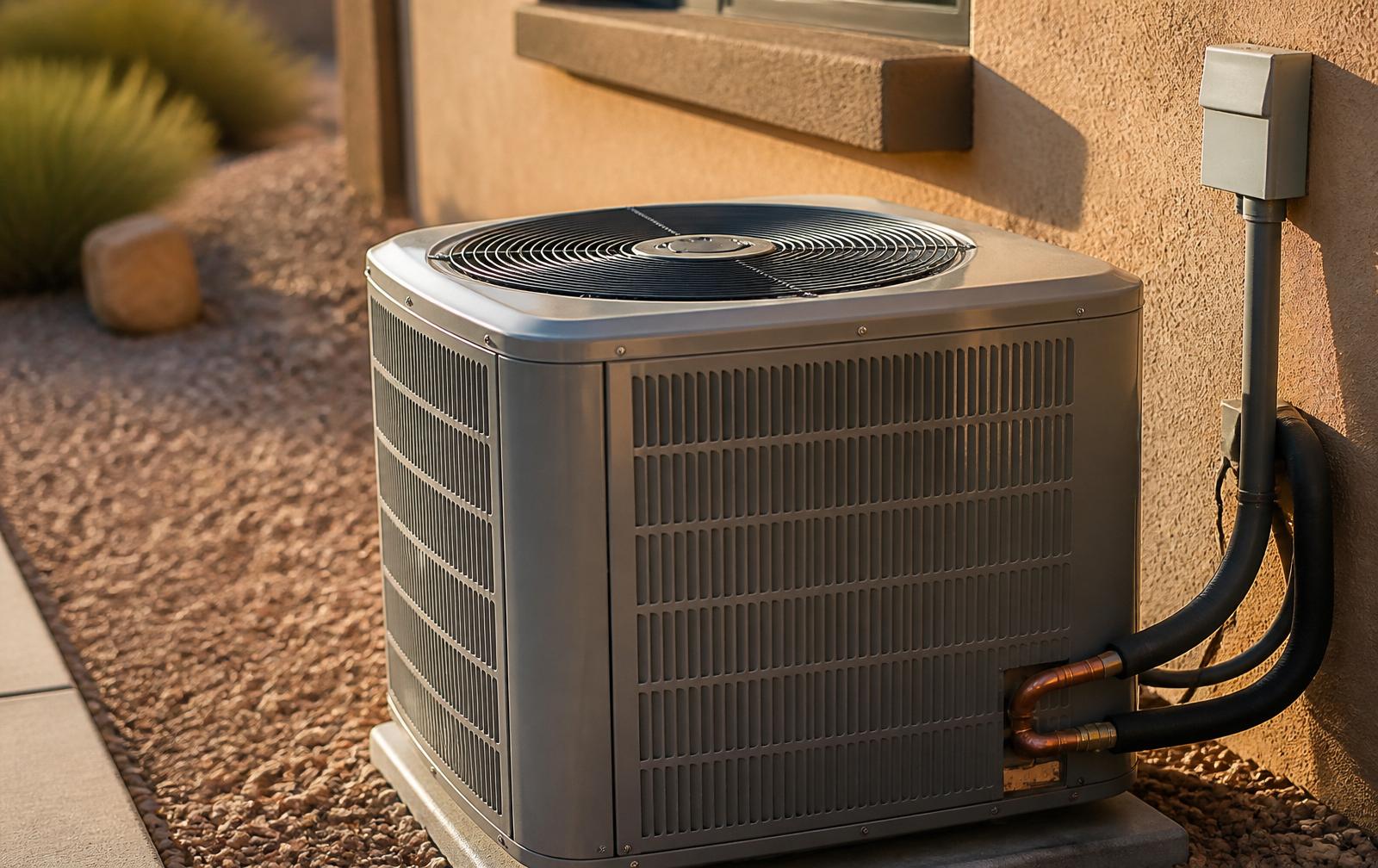
1. Look at the thermostat. Is it set to COOL (not FAN or AUTO on heat) and is the target at least 4 degrees below the room temperature? A dead thermostat battery is the number one false alarm we get dispatched to. 2. Pull the air filter. If it looks gray or you cannot see light through it, that is your problem or a big part of it. A clogged filter starves the system, drops airflow, and can freeze the indoor coil solid in under an hour in Phoenix. 3. Walk outside to the condenser. Is the big outdoor fan spinning? Is the unit humming but the fan is still? A stuck fan means the capacitor, and continuing to run it will cook the compressor. 4. Look at the copper line going into the house. If there is visible ice on it, the coil is frozen. Turn the system to OFF at the thermostat, leave the fan on AUTO, and let it thaw for a few hours before running again. 5. Check the breaker panel. A tripped double breaker for the AC means the unit pulled too much amperage. Reset it once. If it trips again, stop and call. Repeatedly resetting a tripped AC breaker is how compressors die.
If none of those five things solved it, you have a repair call, not a homeowner fix.
Why Phoenix AC units stop cooling above 110 degrees
Residential air conditioners in the United States are rated to cool your home to roughly 20 degrees below outdoor temperature at peak load. That is the design spec, not a Phoenix promise. When it is 115 outside, physics says the best a healthy 10-SEER older unit can deliver inside is around 78 to 80 degrees, even if everything is working perfectly.
That is called heat derating. Every AC loses capacity as outdoor temperature climbs because the condenser has less temperature differential to reject heat into. Add a dirty condenser coil coated in Phoenix dust and monsoon grit, a slightly low refrigerant charge, or ductwork running through a 140-degree attic, and you get a unit that ran fine in May and cannot keep up in July.
So before assuming the unit is broken, ask: is my house 78 when it is 115 out? That is normal. Is my house 88 when it is 105 out? That is a repair.
The 6 most common causes we see on Valley service calls
In rough order of what our techs actually find:
1. Failed run capacitor. Cheap part, big symptom. The outdoor fan will not spin or the compressor hums and stalls. Very common in Phoenix heat because capacitors are heat-rated components living inside 140-degree condenser housings. 2. Dirty condenser coil. Dust, cottonwood fluff, pool chemicals, and monsoon dirt cake the outdoor coil. The system runs but cannot reject heat. A professional coil wash restores performance. 3. Low refrigerant from a slow leak. Older R-22 systems especially. Symptoms: warm air, ice on the copper suction line, longer and longer run times. 4. Frozen evaporator coil. Usually caused by a dirty filter, low refrigerant, or a failing blower motor. Once it freezes, cooling stops until it thaws. 5. Failing blower motor or ECM module. Airflow drops, cooling drops, and the coil eventually freezes. Common on units past year 10. 6. Compressor failure. The expensive one. Almost always a downstream failure of one of the five above that was ignored too long. This is the diagnosis that starts the repair versus replace conversation.
Frozen coil, dirty filter, low refrigerant: how to tell them apart
These three get confused constantly because they can all produce lukewarm air. Quick tells:
Frozen coil: you can literally see frost or ice on the copper line entering the house, or the indoor unit is dripping heavily from the pan. Air from vents is weak and cool, then stops entirely.
Dirty filter: airflow from vents feels weak everywhere. Filter is visibly gray. Often causes the frozen coil above if left long enough.
Low refrigerant: airflow is normal but temperature is warm. Copper line at the outdoor unit is not cold to the touch. Run times are getting longer month over month. This one needs a licensed tech with gauges and leak-detection tools. Do not let anyone add refrigerant without finding the leak first.
What AC repair in Phoenix actually costs in 2026
Real Valley pricing our dispatch quotes today, parts and labor, on a standard single-family home:
Diagnostic service call: $89 to $129, waived on most repairs. Run capacitor replacement: $180 to $340. Contactor replacement: $200 to $350. Condenser fan motor: $450 to $850. Blower motor replacement: $600 to $1,200. Refrigerant leak search plus repair plus recharge (R-410A): $650 to $1,800 depending on where the leak is. Evaporator coil replacement: $1,400 to $2,600. Compressor replacement on a 10-year-old unit: $2,200 to $3,800 and honestly, at that number, you are inside replace-the-unit territory.
Emergency after-hours service adds roughly $95 to $175 depending on the hour. Anyone quoting you a flat $59 or telling you the whole system needs to be replaced sight-unseen is not the company you want. Get an itemized diagnosis in writing before you approve work.
When it is an emergency: shut it off now vs wait until morning
Shut the system off at the thermostat right now if any of these are happening: burning smell from vents, water actively leaking through a ceiling under the air handler, ice covering the copper line, the outdoor unit is buzzing loudly but not running, or the breaker keeps tripping. Continuing to run the system through any of these can turn a $300 repair into a $4,000 one.
It can wait until morning if: cooling is weak but the house is holding under 85, no unusual sounds or smells, no ice, no leaks, and outdoor temperature is dropping overnight. Set the thermostat to 82, close blinds on west-facing windows, run ceiling fans, and book a same-day appointment first thing.
If your home has anyone medically vulnerable, a pet that cannot regulate heat, or the indoor temperature is climbing past 90, that is an emergency regardless. Call our emergency service line and we will get a tech routed.
Repair vs replace: the honest math for a 10+ year old unit
The rule we give homeowners: multiply the age of the unit by the repair quote. If that number is above $5,000, replacement usually wins on 5-year total cost. A $1,000 compressor repair on a 12-year-old R-22 unit is $12,000 by that math, and you are pouring money into a platform the EPA phased out.
Signs it is time to replace, not repair: the unit is 12+ years old, it uses R-22 refrigerant, this is the second major repair in two years, or the tech says compressor. Signs to repair: unit is under 10 years old, refrigerant is R-410A, and the failed part is a capacitor, contactor, fan motor, or leaking Schrader valve.
New high-SEER equipment in Phoenix typically pays back the premium over standard efficiency in 4 to 6 summers of run time. Financing and manufacturer rebates change that math further.
Where to go next
For same-day professional diagnosis anywhere in the Valley, book through our HVAC Services page at /services/hvac-services or call our emergency line at /emergency-service.
If your unit is holding on but you know it is due, our Central Care Club maintenance plans at /maintenance-plans catch capacitor and refrigerant issues in spring before they strand you in July.
For a companion read on prevention, our Phoenix AC tune-up guide at /blog/phoenix-ac-tune-up-guide explains what a real tune-up should include and what it should cost.
We service 11 Valley cities. Confirm your ZIP at /areas-served.
Need a Phoenix tech today?
Talk to a real Valley dispatcher - same-day appointments and live answer 24/7.