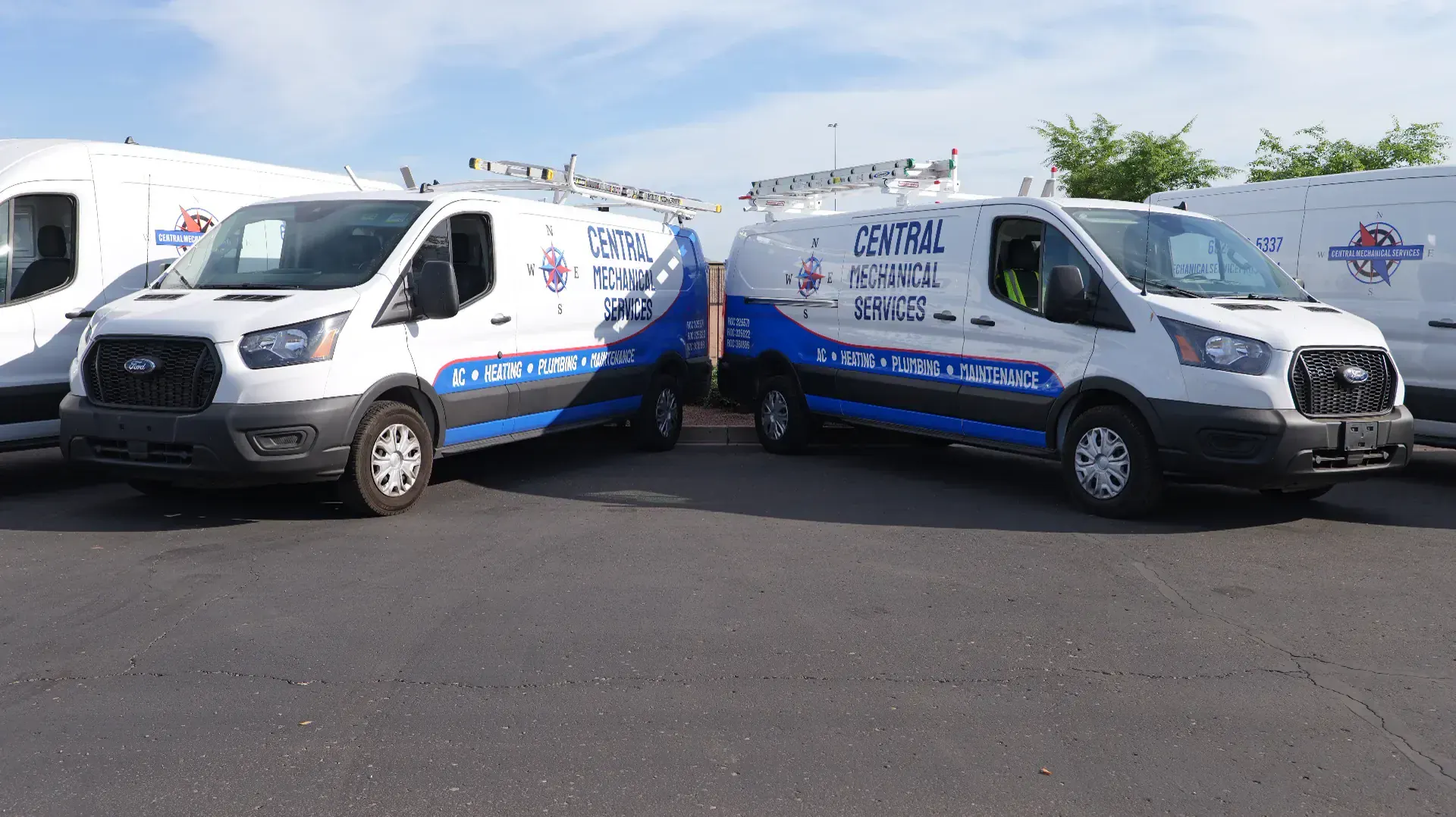
By the Central Mechanical Services LLC team
Licensed Phoenix mechanical contractor - AZ ROC #325571 & #325622
The short version
- An RTU, or rooftop unit, is a packaged commercial air conditioner that holds the compressor, condenser, evaporator, blower, and controls in one cabinet on the roof, which is why most Valley retail, office, and light industrial buildings run on them.
- Phoenix rooftop units live in extreme ambient heat and direct sun, so condenser coil condition and airflow decide whether a building stays comfortable in July.
- Most commercial rooftop HVAC repair calls trace back to capacitors, contactors, condenser fan motors, dirty coils, belts and bearings, refrigerant leaks, or an economizer stuck in the wrong position, not to a dead compressor.
- Short cycling, warm air on the hottest afternoons, rising utility cost, and a unit that trips on high pressure are the early signals worth acting on before a peak season failure.
- Rooftop replacement is a crane, curb, electrical, and structural conversation as much as an equipment conversation, so the contractor quoting it should be licensed for commercial mechanical work in Arizona.
In this article (9 sections)
- 01What an RTU is and why Valley buildings run on them
- 02Why rooftop units fail differently in Phoenix
- 03Warning signs, and what each one usually means
- 04What a commercial rooftop HVAC service call should include
- 05Rooftop and commercial cooling equipment we see across Valley buildings
- 06Rooftop HVAC maintenance that actually prevents failures
- 07Repair or replace a commercial rooftop unit
- 08What drives commercial rooftop HVAC repair cost
- 09How to choose a commercial HVAC contractor for rooftop work
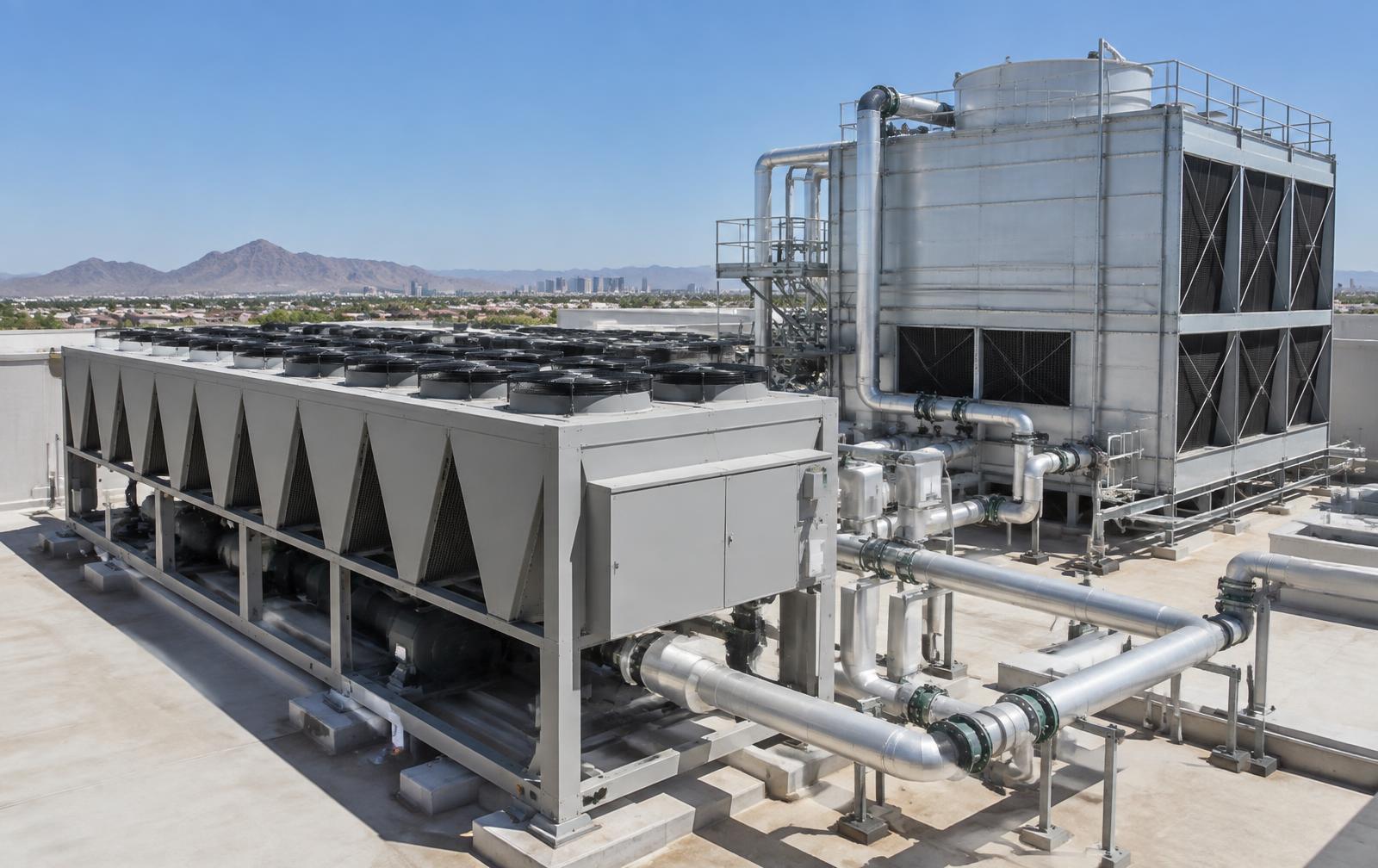
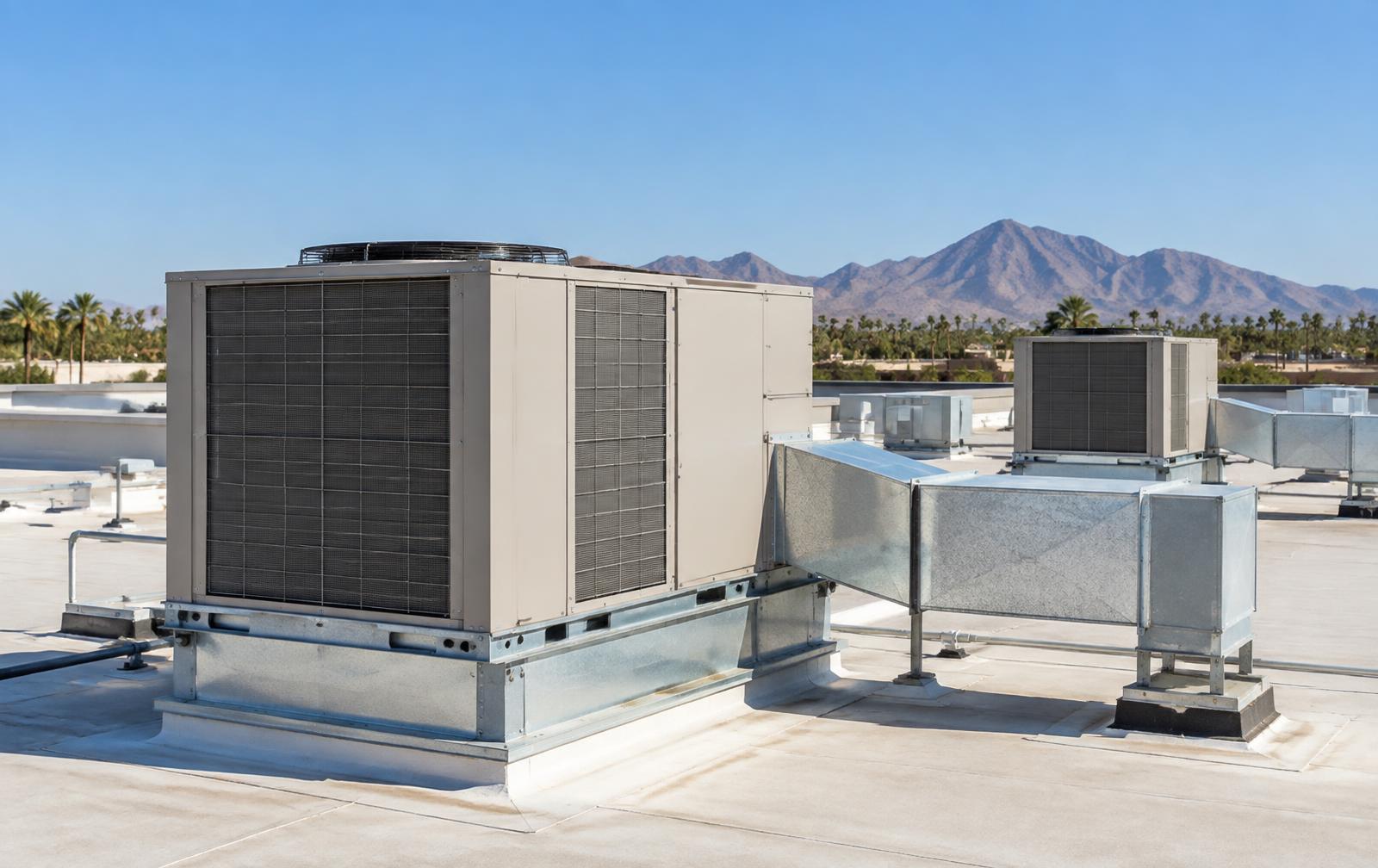
Walk the roof of almost any shopping center, medical office, school, warehouse, or restaurant in the Valley and you will find the same thing: a row of packaged rooftop units doing all of the heating and cooling for the space below. An RTU, short for rooftop unit, is a self contained commercial air conditioner. The compressor, condenser coil, evaporator coil, supply blower, filters, controls, and often a gas heat section all live inside one weatherproof cabinet that sits on a curb and ducts straight down into the building.
That packaging is what makes rooftop units attractive. It also means every part that can fail is sitting in full Phoenix sun, on a surface that can be significantly hotter than the air temperature, for months at a time. This guide covers why commercial rooftop HVAC units fail the way they do here, what the warning signs point to, what a legitimate RTU service call should include, what preventive maintenance actually prevents, when replacement beats another repair, what drives commercial air conditioning repair cost, and how to choose a contractor for rooftop work. Central Mechanical Services LLC is a Phoenix mechanical contractor licensed under AZ ROC #325571 (CR-39 HVAC and Refrigeration) and AZ ROC #325622 (CR-37 Plumbing), holds a KB-1 Dual Building Contractor license, and is bonded and insured, with NATE certified and EPA 608 certified technicians handling commercial mechanical systems across the Valley.
What an RTU is and why Valley buildings run on them
A rooftop unit is a packaged system, which simply means the whole refrigeration circuit and the air handling equipment ship as one assembly rather than as a split system with an indoor furnace or air handler and a separate outdoor condenser. Conditioned air leaves the unit through a supply duct that drops through the roof curb, moves through the space, and returns to the same cabinet.
Commercial buildings favor this arrangement for practical reasons, and those same reasons shape how the equipment should be serviced.
No mechanical room needed
The equipment sits above the tenant space instead of consuming leasable square footage, which matters in retail and office buildings.
Zoning by unit
A multi tenant strip center can give each suite its own rooftop unit, so one tenant's schedule and setpoint do not affect the neighbors.
Service without entering the space
Technicians work on the roof rather than in an occupied lobby, exam room, or sales floor, so most commercial air conditioning repair happens without disrupting business.
Simple replacement path
A like for like changeout can often reuse the existing curb and duct connections, which shortens the downtime window compared to rebuilding a split system.
Integrated heat
Most Valley rooftop units include a gas or electric heat section, so the same cabinet covers the handful of cold mornings Phoenix gets each winter.
The tradeoff is exposure. Everything that makes a rooftop unit convenient also puts the entire system outdoors, on a hot surface, where nobody looks at it until the space gets warm.
Why rooftop units fail differently in Phoenix
Air conditioning works by moving heat out of a building and rejecting it into outdoor air. In Phoenix, that outdoor air is already near the top of the equipment's design range for a large part of the year, and a dark roof surface makes the air entering the condenser hotter still. Almost every pattern below comes back to that one condition.
Extreme ambient heat rejection
- The condition
- The condenser has to push heat into air that sits at or above design temperature for months, with roof surface heat adding to it.
- What it causes
- High head pressure, reduced cooling capacity in the afternoon, high pressure lockouts, and compressors working at the edge of their envelope for entire seasons.
Dust and coil fouling
- The condition
- Desert dust, landscaping debris, and kitchen or shop exhaust settle on condenser coils that sit in the open.
- What it causes
- An insulating blanket on the coil that blocks heat transfer. It looks like a refrigerant problem, and it kills compressors that were otherwise healthy.
UV and thermal cycling
- The condition
- Direct sun and daily temperature swings age everything exposed: cabinet panels, gaskets, wire insulation, belts, and rooftop duct wrap.
- What it causes
- Cracked belts, brittle wiring, failed capacitors, and air leaking out of supply ductwork before it ever reaches the space.
Long continuous run hours
- The condition
- Valley cooling season runs far longer than the national average, and many rooftop units approach continuous operation in summer.
- What it causes
- Bearings, blower motors, contactors, and condenser fan motors accumulate wear hours much faster than nameplate expectations assume.
Monsoon storms and power events
- The condition
- Dust storms drive debris into coils, and outages, brownouts, and surges hit Valley buildings during storm season.
- What it causes
- Clogged coils overnight, plus failed contactors, start components, and control boards that often show up days after the storm rather than during it.
Economizer neglect
- The condition
- Economizer dampers, actuators, and linkages sit outdoors and are rarely inspected on unmaintained units.
- What it causes
- A damper stuck open pulls hot outside air into the building all summer, which drives up both the utility bill and the complaints.
In this climate, rooftop reliability is mostly a heat rejection problem. Keep the condenser clean, the airflow unobstructed, and the economizer in the right position, and most emergency calls never happen.
Warning signs, and what each one usually means
Rooftop units almost always signal trouble before they stop. Because nobody is standing next to the equipment, those signals show up as comfort complaints, utility cost, or nuisance resets instead. Here is what each one typically points to.
Warm air on the hottest afternoons
- What you see
- The space holds fine in the morning and drifts several degrees warm from early afternoon onward.
- Usual causes
- Dirty condenser coil, low refrigerant charge, a weak or failing condenser fan motor, or capacity that no longer matches the load.
The unit short cycles
- What you see
- The compressor starts, runs briefly, shuts down, and restarts a few minutes later.
- Usual causes
- High pressure trips from restricted condenser airflow, a failing capacitor or contactor, a low charge, or an oversized unit for the current load.
Breaker trips or high pressure lockouts
- What you see
- The unit is dead when someone checks it, and resetting brings it back for a while.
- Usual causes
- Head pressure climbing past the safety limit, a locked rotor condition, failing electrical components, or a condenser fan that is not turning.
Weak airflow at the diffusers
- What you see
- Vents blow less than they used to, and the far end of the space never gets comfortable.
- Usual causes
- Loaded filters, a slipping or broken belt, a failing blower motor, an iced evaporator coil, or separated and leaking rooftop duct connections.
Noise from the roof
- What you see
- Grinding, squealing, rattling, or a hard thump when the unit starts.
- Usual causes
- Worn blower or fan bearings, a belt in poor condition, loose panels and cabinet fasteners, or compressor start components on their way out.
Utility cost climbing without a use change
- What you see
- Occupancy and hours are the same, and the electric bill is not.
- Usual causes
- Fouled coils, refrigerant charge drift, an economizer stuck open, bad setpoints or schedules, or heat and cool fighting each other on a failed control.
Water stains on the ceiling below
- What you see
- Discoloration on ceiling tile near the unit, usually first seen in summer.
- Usual causes
- A plugged condensate drain or pan, a failed pan, or a curb and flashing detail that is letting water in around the unit.
A rooftop unit that needs a reset every few weeks is not a unit with a mystery. It is a unit telling you a component is failing under peak load, and peak load in Phoenix is exactly when you cannot afford to lose it.
What a commercial rooftop HVAC service call should include
There is a real difference between a technician who changes a part and one who determines why the part failed. On a rooftop unit in this climate, the second approach is what keeps the same call from repeating in three weeks. A complete service visit should follow roughly this order.
- 1
Confirm the complaint and the conditions
Space temperature, setpoints, schedules, occupancy, and what changed recently. Many rooftop calls turn out to be thermostat programming, a locked out economizer, or a control issue rather than mechanical failure.
- 2
Inspect the unit and the roof around it
Cabinet condition, panel fasteners, curb and flashing, condensate routing, obstructions near the condenser, and whether anything nearby is recirculating hot discharge air back into the coil.
- 3
Check airflow first
Filters, belt condition and tension, blower wheel cleanliness, motor amperage, and evaporator coil condition. Airflow problems create symptoms that look exactly like refrigerant problems.
- 4
Evaluate the condenser and heat rejection
Coil cleanliness through the full depth, fin condition, fan blade and motor operation, and whether the unit can actually reject heat at current ambient temperature.
- 5
Take electrical readings
Voltage, amperage under load, capacitor values, contactor condition, terminal tightness, and safety controls. Heat and vibration loosen and degrade these faster here than in mild climates.
- 6
Verify refrigerant charge by measurement
Pressures and temperatures interpreted against the equipment's own data, not topped off by feel. If the charge is low, the leak gets found and addressed, because refrigerant does not get consumed.
- 7
Test controls, safeties, and the economizer
Sequence of operation from a call for cooling through staging, economizer position, damper travel, sensors, and shutdown. A stuck economizer is one of the most common and most expensive overlooked faults in the Valley.
- 8
Document findings and give options
What failed, why it failed, what was corrected, what is marginal, and what the building should plan for. Photos from the roof matter here, because the owner is never standing next to the equipment.
If a rooftop unit keeps failing in the same way, the repair is not finishing the job. Recurring failures point to airflow, heat rejection, electrical supply, or sizing, and those are diagnosis questions rather than parts questions.
Rooftop and commercial cooling equipment we see across Valley buildings
Commercial air conditioning in Phoenix is not one type of machine. A single property can carry several of the following, each with its own failure pattern and service scope.
Packaged rooftop units
Gas heat and electric cooling or all electric heat pump versions, from small single zone units over a suite to large multi stage units serving open retail and warehouse space.
Multi zone and VAV rooftop systems
Larger units feeding variable air volume boxes throughout an office floor, where a comfort complaint can originate at the unit, at the box, or in the controls.
Split system commercial AC
Indoor air handlers with separate outdoor condensing units, common in older buildings, tenant improvements, and spaces where rooftop weight is a problem.
Ductless mini split systems
Server rooms, IDF closets, breakrooms, and additions that need dedicated cooling independent of the main rooftop unit schedule.
Make up air and exhaust equipment
Restaurants and shops where the building cannot stay balanced or comfortable unless the air being exhausted is properly replaced.
Heat pumps and electric heat sections
Increasingly common on newer Valley construction, with their own defrost, staging, and control considerations.
Rooftop ductwork and distribution
Supply and return duct, insulation, and connections that sit in the sun and quietly leak conditioned air out of the system.
Controls and building automation points
Thermostats, sensors, schedules, and economizer controls that decide whether well maintained equipment actually runs the way it should.
Because our team is licensed for both mechanical and plumbing work, a rooftop issue that turns out to be a condensate, drainage, or gas piping problem does not require a second contractor and a second visit.
Rooftop HVAC maintenance that actually prevents failures
Preventive maintenance on rooftop units is often sold as filters and a checklist. In this climate, the items that genuinely change outcomes are specific, and most of them are about heat rejection and airflow.
Deep condenser coil cleaning before summer
Not a rinse of the outer surface. Dust packs into the coil depth here, and cleaning it properly is the single highest value maintenance task on a Phoenix rooftop.
Filter program matched to the environment
Filter intervals that reflect dust load and occupancy rather than a generic schedule, because loaded filters starve airflow and freeze coils.
Belt, bearing, and blower service
Belt condition and tension checked and corrected, bearings inspected, and blower wheels cleaned so the unit moves the air it was designed to move.
Electrical inspection under load
Capacitors measured, contactors inspected for pitting, connections tightened, and amperage compared to nameplate before peak season loads them.
Economizer inspection and calibration
Damper travel, actuator function, linkage condition, and sensor accuracy verified so the unit is not pulling in outside air during a July afternoon.
Condensate and drain pan service
Pans cleared, drains flushed, and traps checked so summer condensate leaves the roof instead of finding the ceiling tile below.
Refrigerant circuit verification
Charge confirmed by measurement and small leaks caught while they are still small, which protects the compressor and keeps capacity where it belongs.
Cabinet, curb, and duct integrity
Panel fasteners, gasketing, curb flashing, and rooftop duct connections checked, because conditioned air lost on the roof is money spent cooling the sky.
Planned maintenance also changes the economics of failure. A building on a maintenance program gets known equipment, documented history, and a technician who has already seen that rooftop unit, which shortens diagnosis when something does break. Our preventative maintenance programs are built around that idea.
Repair or replace a commercial rooftop unit
There is no universal age at which a rooftop unit should be replaced. The honest way to make the call is to weigh the condition of the expensive components against the cost and disruption of continuing to repair. These are the factors that actually decide it.
Age and duty in this climate
- What to look at
- Valley rooftop units accumulate far more run hours per year than equipment in mild climates, so calendar age understates wear.
- How to read it
- A unit well into its service life with heavy Phoenix run hours is a replacement candidate even when it is currently running.
Compressor or coil failure
- What to look at
- A failed compressor or a leaking evaporator or condenser coil on an aging unit.
- How to read it
- These are the repairs that approach a meaningful share of replacement cost, which is usually the point where replacement becomes the better spend.
Refrigerant type and parts availability
- What to look at
- Older units may use refrigerants that are being phased down, and parts support thins out as models age.
- How to read it
- Rising refrigerant cost and slower parts sourcing both push toward replacement, especially where downtime is expensive.
Repair frequency and downtime cost
- What to look at
- Two or three service calls a season on the same unit, each one during business hours.
- How to read it
- Add the disruption to the invoices. Recurring failures on a peak summer day usually cost more than the repair line items suggest.
Efficiency and utility spend
- What to look at
- An older unit running long hours against a long Valley cooling season.
- How to read it
- The operating cost difference is real in this climate and belongs in the comparison rather than being treated as a bonus.
Load and use changes
- What to look at
- Tenant improvements, added occupancy, new equipment loads, or a space repurposed since the unit was installed.
- How to read it
- If the unit no longer matches the load, another repair will not fix comfort. Replacement is a chance to size the system to the building as it is used today.
Rooftop replacement is a logistics project as well as an equipment purchase. Crane access, curb compatibility or a curb adapter, electrical service, structural support, roofing details, and the downtime window all belong in the quote before anyone talks about brand.
What drives commercial rooftop HVAC repair cost
Pricing varies by building and by scope, so instead of numbers that would not apply to your property, here are the factors that move the cost of commercial air conditioning repair in Phoenix.
Which component failed
A capacitor, contactor, or belt sits at one end of the range. A compressor, coil, or control board sits at the other.
Diagnosis complexity
An intermittent fault, a controls problem, or a unit that fails only at peak ambient temperature takes longer to prove out than a clear hard failure.
Access and rigging
Roof access, equipment location, and whether a component can be swapped by hand or needs lifting equipment all affect labor.
Refrigerant work
Leak location, repair, evacuation, and recharge are regulated work, and refrigerant type and quantity affect the total.
Timing
After hours, weekend, and holiday emergency response is priced differently than scheduled work, which is one more argument for catching problems in the spring.
Parts sourcing
Readily stocked components cost less and arrive faster than obsolete or special order parts for aging equipment.
Condition of the rest of the unit
A unit that has been maintained needs one repair. A unit that has not often needs the repair plus the deferred items that caused it.
The most expensive rooftop repair is almost always the second one, caused by fixing a symptom without addressing the airflow, heat rejection, or electrical condition underneath it.
How to choose a commercial HVAC contractor for rooftop work
Commercial rooftop work is not residential air conditioning at a larger scale. Licensing, refrigerant handling, roof safety, and building impact all differ. Use these as screening questions before an emergency forces a fast decision.
Arizona licensing for commercial mechanical work
Ask for the ROC license number and confirm the classification covers commercial HVAC and refrigeration. Central Mechanical Services LLC holds AZ ROC #325571 (CR-39 HVAC and Refrigeration) and AZ ROC #325622 (CR-37 Plumbing), along with a KB-1 Dual Building Contractor license.
EPA 608 certified technicians
Refrigerant handling is federally regulated. The person opening a sealed system should be certified, and the contractor should be able to say so without hesitation.
Bonded and insured, with commercial references
Roof work on an occupied building carries real exposure. Verify coverage and confirm the contractor regularly works on properties like yours.
True 24/7 dispatch
Rooftop failures do not wait for Monday. Ask what happens at 9pm in August, and whether an actual technician is dispatched or a message is taken.
Diagnosis documented in writing
You should receive what failed, why, what was done, and what is marginal, with photos from the roof you will never climb.
Maintenance capability, not just repair
A contractor who can put the equipment on a program will know your units before they fail, which is worth more than a fast quote.
One contractor for mechanical and plumbing
Condensate, gas piping, and drainage frequently intersect with rooftop work. Holding both licenses means one company owns the outcome.
Local Valley coverage
Our team serves Phoenix, Scottsdale, Mesa, Tempe, Chandler, Gilbert, Glendale, Peoria and the surrounding Valley, which matters when response time is the whole point.
Founded in 2019 and backed by more than 150 years of combined trade experience, our team works on commercial rooftop units across the Valley every week. If a unit on your roof is short cycling, tripping, or losing the space in the afternoon, get in touch and we will get a technician on the roof.
Need a Phoenix tech today?
Talk to a real Valley dispatcher - same-day appointments and live answer 24/7.