By the Central Mechanical Services LLC team
Licensed Phoenix mechanical contractor - AZ ROC #325571 & #325622
The short version
- A chilled water plant is a central system rather than a single machine, so a comfort complaint on the fourth floor can start at the chiller, the cooling tower, the pumps, the piping, the air handlers, or the controls.
- Phoenix punishes chillers in two specific ways: extreme ambient temperature that raises condensing pressure on air cooled machines, and very hard makeup water that scales condenser tubes and fouls cooling tower fill on water cooled machines.
- Rising approach temperature, climbing condenser pressure, oil that looks or tests wrong, and a tower that cannot hold its design leaving water temperature are the early signals that a central plant is losing capacity before it ever trips offline.
- Most unplanned chiller shutdowns in the Valley trace back to water treatment, scale and fouling, sensor drift, electrical and starter faults, or deferred tube service rather than a catastrophic compressor failure.
- Chiller work is a licensing, refrigerant handling, rigging, and controls project, so the contractor quoting it should hold commercial mechanical credentials in Arizona and employ EPA 608 certified technicians.
In this article (9 sections)
- 01What a chilled water plant is and why large buildings use one
- 02Why chillers and cooling towers fail differently in Phoenix
- 03Warning signs, and what each one usually means
- 04What a commercial chiller service call should include
- 05Central plant equipment we service across Valley facilities
- 06Chiller and cooling tower maintenance that actually prevents downtime
- 07Repair, rebuild, retube, or replace a commercial chiller
- 08What drives commercial chiller and cooling tower repair cost
- 09How to choose a commercial mechanical contractor for chiller work
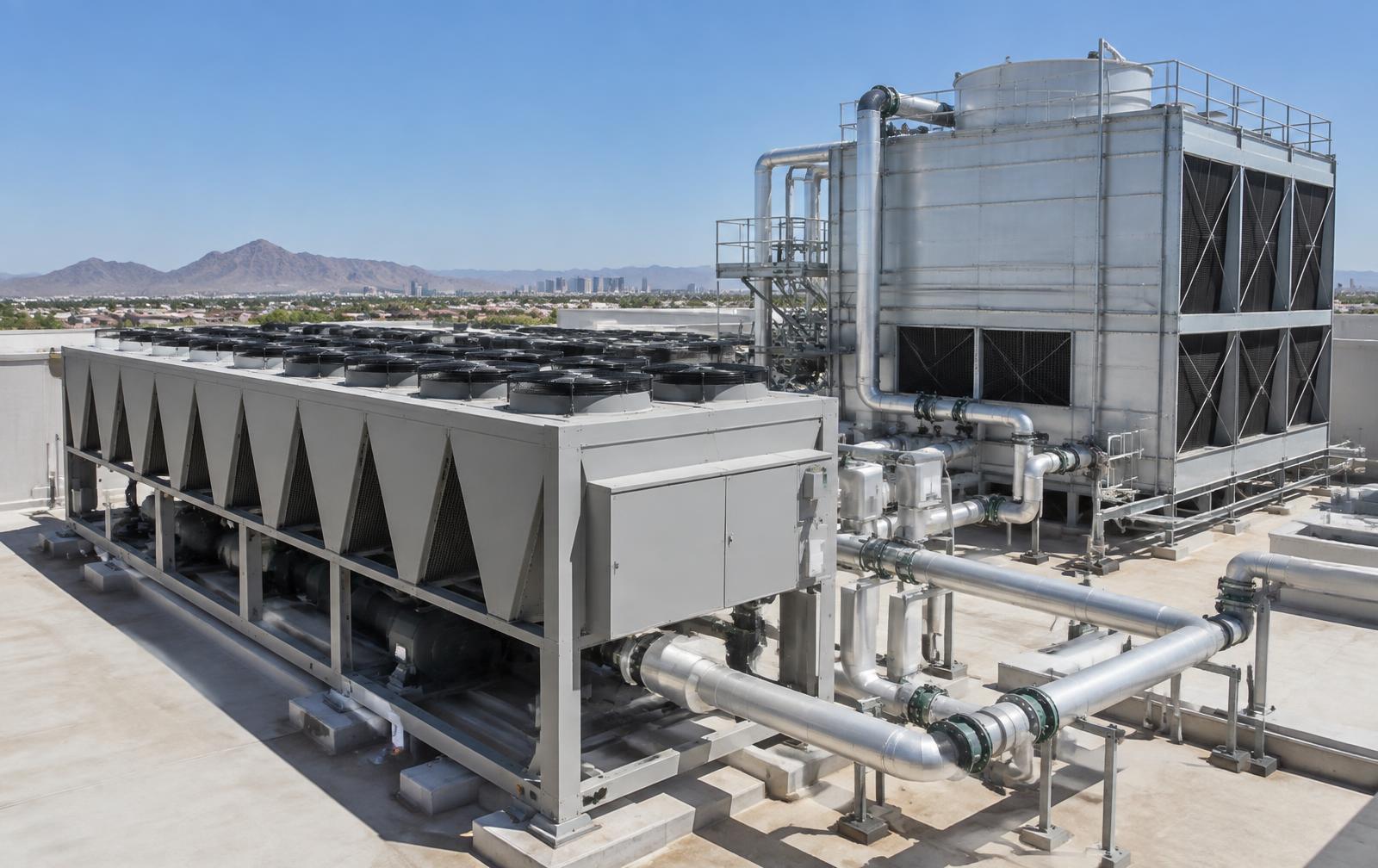
Once a Phoenix building passes a certain size, packaged rooftop units stop being the practical answer. Hospitals, high rise and mid rise office towers, universities and school district campuses, data centers, hotels, large manufacturing plants, and government facilities across the Valley cool themselves with a central plant instead: one or more chillers producing chilled water, pumps moving it through the building, air handlers using it to cool the air, and, on water cooled systems, a cooling tower rejecting all of that collected heat into the sky.
That architecture is efficient and scalable, and it is also unforgiving. A rooftop unit failure takes out one suite. A chiller failure takes out an entire building, and in July in Phoenix that is a closed facility, not an inconvenience. This guide covers how a chilled water plant actually works, why chillers and cooling towers fail differently in this climate, what the warning signs mean, what a legitimate commercial chiller service call should include, the maintenance that genuinely prevents downtime, and when repair, rebuild, retube, or replacement is the right decision. Central Mechanical Services LLC is a Phoenix mechanical contractor licensed under AZ ROC #325571 (CR-39 HVAC and Refrigeration) and AZ ROC #325622 (CR-37 Plumbing), holds a KB-1 Dual Building Contractor license, and is bonded and insured, with NATE certified and EPA 608 certified technicians servicing commercial mechanical systems across the Valley.
What a chilled water plant is and why large buildings use one
A chiller does not cool a building directly. It cools water, typically to somewhere around the mid forties, and that chilled water is pumped through the building to coils inside air handlers and fan coil units, where building air passes across the coil and gives up its heat. The warmed water returns to the chiller, gives up that heat, and goes back out again.
Understanding the pieces matters, because a central plant complaint almost never has one obvious source.
The chiller itself
A large refrigeration machine, air cooled or water cooled, using a centrifugal, screw, or scroll compressor to move heat out of the chilled water loop. This is the heart of the plant and the most expensive single asset in it.
The cooling tower
On water cooled systems, the tower rejects heat by evaporating a portion of the condenser water into the atmosphere. Every gallon evaporated leaves its minerals behind, which is the root of most tower problems in Phoenix.
Chilled water and condenser water pumps
Primary, secondary, and condenser pumps that keep both loops moving at design flow. A pump or valve problem produces symptoms that look exactly like a failing chiller.
Air handlers and fan coil units
The equipment inside the building that actually transfers the cooling into the occupied space, through coils, valves, filters, and fans.
Controls and building automation
Sensors, setpoints, staging logic, variable frequency drives, and sequences that decide when equipment runs and how hard. A correctly repaired plant with bad sequencing still wastes energy and still gets comfort complaints.
Because the pieces are interdependent, diagnosing a central plant means looking at the whole system. A chiller that will not hold setpoint is sometimes a chiller problem and sometimes a flow, fouling, load, or controls problem wearing a chiller costume.
Why chillers and cooling towers fail differently in Phoenix
Every refrigeration machine has to reject the heat it removes into something. In the Valley, that something is either air that is already extremely hot or water that is extremely hard, and both conditions shape the failure patterns below.
Extreme ambient on air cooled machines
- What happens
- Air cooled chillers must reject heat into outdoor air that sits near the top of their design range for months at a time, driving condensing pressure up.
- Why it matters
- Higher head pressure means lost capacity, higher energy use per ton, more compressor stress, and safety trips on the hottest afternoons, which is exactly when the building needs full output.
Hard water and scale on condenser tubes
- What happens
- Valley makeup water carries a heavy mineral load. As tower water evaporates, minerals concentrate and deposit inside condenser tubes as scale.
- Why it matters
- Scale is an insulator. A thin layer measurably raises condensing temperature, cuts efficiency, and pushes the machine toward high pressure shutdowns long before anything sounds wrong.
Fouling and biological growth in the tower
- What happens
- Warm, aerated, open water in full sun is ideal for biological growth, and airborne dust loads the basin and fill.
- Why it matters
- Fouled fill and a dirty basin reduce heat rejection, raise condenser water temperature, and drag the whole plant's efficiency down while accelerating corrosion.
Dust loading on coils and air paths
- What happens
- Blowing dust and construction activity pack the depth of air cooled condenser coils and load tower air inlets and drift eliminators.
- Why it matters
- Restricted airflow has the same effect as scale. The machine can no longer reject the heat it is removing, so it works harder for less output.
Water loss, cycles, and chemistry drift
- What happens
- High evaporation rates mean high makeup and blowdown volumes, and chemical feed that drifts out of range does so quickly here.
- Why it matters
- Chemistry that runs too aggressive corrodes tubes and piping. Chemistry that runs too conservative scales them. Both outcomes are expensive and both are preventable.
Thermal and electrical stress on drives and starters
- What happens
- Variable frequency drives, starters, contactors, and terminations run hot in mechanical rooms and rooftop enclosures that are already hot.
- Why it matters
- Heat degrades insulation and connections, and a large share of unplanned plant shutdowns in the Valley are electrical faults rather than mechanical failures.
Almost every chiller efficiency problem in Phoenix comes back to heat rejection. Whether the barrier is scale inside a tube, fouling on tower fill, or dust in an air cooled coil, the machine is being asked to push heat through something that will not let it pass.
Warning signs, and what each one usually means
Central plants rarely fail without warning. They lose capacity gradually, and the operating data shows it well before the building gets warm. These are the signals worth acting on.
Rising approach temperature
- What you see
- The difference between refrigerant temperature and leaving water temperature in the condenser or evaporator is wider than it used to be at the same load.
- Usual causes
- Scale or fouling on the tube surfaces, low flow through the bundle, air or noncondensables in the machine, or a charge issue. Approach is the single most useful trend a plant operator can watch.
High condenser pressure and nuisance trips
- What you see
- The chiller shuts down on a high pressure safety during peak afternoon load and restarts fine later.
- Usual causes
- Fouled condenser tubes, a cooling tower not holding its design temperature, a dirty air cooled coil, failed condenser fans, or condenser water flow that has fallen off.
Chilled water temperature hunting
- What you see
- Leaving chilled water swings above and below setpoint instead of holding steady, and comfort complaints follow it around the building.
- Usual causes
- Sensor drift, poor staging or sequencing logic, valve or actuator problems, low delta T across the loop, or a plant oversized for the current load profile.
Oil pressure, level, or condition alarms
- What you see
- Oil related alarms, a changed oil level, or oil that looks discolored at a sight glass.
- Usual causes
- Bearing wear, refrigerant migrating into the oil, filter restriction, or moisture and acid in the system. Oil analysis catches these while they are still repairable.
Unusual vibration or noise from the machine
- What you see
- New vibration at the compressor, motor, or pump, or a rumble and surge sound on a centrifugal machine.
- Usual causes
- Bearing degradation, impeller or coupling issues, misalignment, or a centrifugal running in surge because of condenser conditions or low load operation.
Cooling tower problems you can see
- What you see
- White scale on the fill, slime or discoloration in the basin, water spilling over, drift blowing off the tower, or a fan that groans and shakes.
- Usual causes
- Chemistry out of range, plugged distribution nozzles, a failed float or makeup valve, damaged drift eliminators, or fan bearing, belt, and gearbox wear.
Energy cost rising without an occupancy change
- What you see
- Same hours, same tenants, higher electric and water use across the season.
- Usual causes
- Fouled heat transfer surfaces, poor tower performance, pumps running at full speed unnecessarily, simultaneous heating and cooling, or a plant staging more machines than the load requires.
A plant that needs a manual reset every few weeks is not mysterious. It is a machine operating at the edge of a safety limit, and in this climate that edge gets thinner every week from May through September.
What a commercial chiller service call should include
There is a meaningful difference between clearing an alarm and finding out why the alarm happened. On a central plant, the second approach is the only one that protects a building through a Phoenix summer. A complete service visit should follow roughly this order.
- 1
Review the operating data before touching anything
Trend logs, alarm history, run hours, staging behavior, setpoints, and load profile. A chiller's own data usually names the problem before any gauge goes on the machine.
- 2
Verify sensors and controls first
Temperature and pressure sensor accuracy, transducer calibration, valve and actuator position, and whether the sequence of operation matches how the building is actually used. Drifted sensors create failures that do not exist.
- 3
Calculate approach temperatures at real load
Evaporator and condenser approach compared against the machine's design values. This is the measurement that separates a fouling problem from a refrigerant or flow problem.
- 4
Confirm water flow through both loops
Chilled water and condenser water flow, pressure drop across the bundles, strainer condition, pump performance, and delta T across the system. Low flow mimics almost every other chiller fault.
- 5
Inspect the refrigerant circuit and check for leaks
Pressures and temperatures interpreted against equipment data, purge unit run time on low pressure machines, and leak detection handled under EPA 608 requirements. Refrigerant does not get used up, so a low charge means a leak to find.
- 6
Sample and evaluate the oil
Oil condition, level, filter differential, and a laboratory sample where appropriate. Oil analysis reveals bearing wear, moisture, and acid long before those conditions reach the compressor.
- 7
Inspect electrical components under load
Starter or variable frequency drive condition, motor winding readings, amperage against nameplate, contactor and terminal condition, and thermal inspection of connections in a hot mechanical space.
- 8
Service and assess the cooling tower as part of the same call
Basin and fill condition, distribution and nozzles, drift eliminators, float and makeup, fan motor, belts or gearbox, vibration, and coordination with the water treatment program. A chiller cannot outperform its tower.
If a chiller keeps tripping in the same way, parts are not the answer. Recurring shutdowns point to heat rejection, water flow, water chemistry, electrical supply, or control sequencing, and every one of those is a diagnosis question rather than a parts question.
Central plant equipment we service across Valley facilities
Commercial cooling at this scale is not one machine type. A single campus can carry several of the following, each with its own service scope and failure pattern.
Air cooled chillers
Common on Valley office, retail, school, and light industrial properties where no condenser water system exists. Coil condition and fan performance decide whether they hold capacity in July.
Water cooled chillers
Paired with a cooling tower, typically on larger or more efficiency sensitive buildings. Tube cleanliness and water chemistry are the controlling maintenance factors.
Centrifugal chillers
Large tonnage machines serving hospitals, towers, and campuses, with surge behavior, purge systems, and bearing health as the critical service items.
Screw and scroll chillers
Mid range machines common in manufacturing, process cooling, and mid size commercial buildings, valued for good part load performance and staging flexibility.
Induced and forced draft cooling towers
Open tower designs where fill condition, drift eliminators, distribution, fan drives, and basin cleanliness determine how much heat the plant can actually reject.
Closed circuit coolers and fluid coolers
Used where the process or building loop must stay isolated from open tower water, with their own coil cleaning and spray water considerations.
Pumps, valves, piping, and heat exchangers
Primary and secondary pumping, control and isolation valves, strainers, plate and frame exchangers, and the insulated piping that ties the plant to the building.
Controls, drives, and building automation points
Sensors, staging logic, variable frequency drives, schedules, and the sequences that decide whether well maintained equipment actually runs efficiently.
Because our team is licensed for both mechanical and plumbing work, a central plant issue that turns out to be condenser water piping, makeup water, drainage, or backflow does not require a second contractor and a second mobilization.
Chiller and cooling tower maintenance that actually prevents downtime
Central plant maintenance is often sold as a quarterly visit and a filter list. In this climate the tasks that genuinely change outcomes are specific, and most of them protect heat transfer surfaces and water chemistry.
Condenser tube cleaning on a real interval
Brushing or punching the tube bundle based on approach trends and water conditions rather than a generic schedule. On Valley water, this is the highest value task in the plant.
A water treatment program that is verified, not assumed
Chemical feed, conductivity and cycles of concentration, corrosion coupons, and biological control checked against results. Treatment that is billed but not performing shows up as scale a year later.
Cooling tower cleaning and fill inspection
Basin cleaned, fill inspected for scale and collapse, nozzles cleared, and drift eliminators checked so the tower can hold its design leaving water temperature.
Air cooled condenser coil cleaning before summer
Cleaned through the full depth of the coil rather than rinsed on the surface, because Valley dust packs into the fin pack and quietly removes capacity.
Oil, filter, and refrigerant service per manufacturer guidance
Oil analysis, filter changes, purge unit monitoring, and eddy current tube testing at appropriate intervals to catch wall thinning before a tube fails.
Vibration and alignment checks on rotating equipment
Compressors, motors, pumps, and tower fans monitored for bearing degradation and misalignment while the correction is still routine.
Electrical inspection and drive maintenance
Starters and drives cleaned and inspected, connections torqued, cooling fans and filters serviced, and readings compared against nameplate before peak season load.
Controls review and log keeping
Setpoints, staging, reset strategies, and schedules reviewed each season, with daily or automated operating logs so trends are visible rather than discovered during a failure.
The point of a maintenance program on a central plant is not tidiness. It is protecting the two things that decide summer reliability: clean heat transfer surfaces and controlled water chemistry.
Repair, rebuild, retube, or replace a commercial chiller
Chillers are long lived assets, and the right decision is rarely obvious from age alone. These are the factors that should drive the conversation.
Component repair
- What to look at
- Sensors, starters, drives, valves, motors, fan assemblies, and controls that fail individually while the pressure vessels and compressor remain sound.
- How to read it
- If heat transfer surfaces and the compressor are in good condition, component repair is usually the right answer and the plant has years of service left.
Compressor overhaul or rebuild
- What to look at
- Bearing wear confirmed by oil analysis and vibration data, or damage found during inspection on a machine that is otherwise solid.
- How to read it
- An overhaul on a well maintained large tonnage machine can be far more economical than replacement, especially when the building cannot absorb a long changeout.
Tube cleaning or retubing
- What to look at
- Approach temperature trends, eddy current test results showing wall thinning or pitting, and any history of tube leaks.
- How to read it
- Fouling is a cleaning problem. Wall loss and pitting are a retube conversation, and a leaking tube that contaminates refrigerant or water makes it urgent.
Refrigerant and obsolescence pressure
- What to look at
- Which refrigerant the machine uses, the cost and availability of that refrigerant, and whether replacement parts and controls are still supported.
- How to read it
- A machine running a refrigerant that is expensive and hard to source, on unsupported controls, becomes a risk even when it is mechanically healthy.
Efficiency and utility cost
- What to look at
- Actual energy use per ton against what current equipment achieves, particularly at the part load conditions where the plant spends most of its hours.
- How to read it
- On a plant that runs as many hours as Valley buildings demand, an efficiency gap compounds quickly and belongs in the replacement math alongside repair cost.
Reliability risk to the operation
- What to look at
- What a two day outage would cost the facility, whether there is redundancy, and how long a critical replacement part would take to arrive.
- How to read it
- A hospital, data center, or production facility with no backup capacity should weight reliability far more heavily than a building that can tolerate a warm afternoon.
Chiller replacement is a logistics project as much as an equipment purchase. Rigging and crane access, mechanical room clearances and door openings, electrical service, structural support, piping modifications, controls integration, and the outage window all belong in the quote before anyone talks about brand.
What drives commercial chiller and cooling tower repair cost
Pricing on central plant work varies more than any other category of commercial HVAC, because the scope varies more. These are the factors that move it.
Tonnage and machine type
A small air cooled packaged chiller and a large tonnage centrifugal are different categories of work in labor hours, tooling, refrigerant volume, and parts cost.
Access and rigging
Rooftop plants, basement mechanical rooms with tight door openings, and equipment that requires a crane pick or disassembly to remove all add real cost before any repair begins.
Refrigerant type and quantity
Large machines hold large charges. Recovery, storage, and recharge are significant line items, and older refrigerants cost considerably more per pound.
Condition of the tube bundles
Cleaning is routine. Eddy current testing, plugging, or full retubing is a different scope entirely, and it is usually driven by years of water treatment history.
Parts availability and lead time
Compressors, drives, control boards, and tower components on older or specialty equipment can carry long lead times, which sometimes makes a temporary measure part of the plan.
Whether the work is planned or an emergency
Scheduled shutdown work during a mild week is far more efficient than emergency response on a July afternoon with the building occupied.
Scope beyond the machine
Pumps, valves, piping, insulation, controls integration, electrical work, and water treatment corrections frequently surface during a chiller project and belong in the budget honestly from the start.
The cheapest quote on central plant work is often the one with the narrowest scope. Ask what was excluded, because scope left out of a proposal does not stay out of the building.
How to choose a commercial mechanical contractor for chiller work
Central plant service is a different qualification level than rooftop or residential work. These are reasonable things to verify before anyone opens a machine.
Arizona commercial mechanical licensing
Ask for the license numbers and confirm they cover commercial HVAC and refrigeration work at this scale. Central Mechanical Services holds AZ ROC #325571 (CR-39) and AZ ROC #325622 (CR-37), plus a KB-1 Dual Building Contractor license.
EPA 608 certified refrigerant handling
Any technician recovering, charging, or leak checking refrigerant on a commercial machine must be certified, and the documentation practices around that work should be routine for them.
Real diagnostic capability
Trend log analysis, approach temperature calculation, oil analysis, vibration monitoring, and eddy current testing access, rather than parts replacement and a reset.
Cooling tower and water treatment competence
A contractor who treats the tower and the chemistry as somebody else's problem cannot actually solve a fouling or efficiency issue on a water cooled plant.
Controls and drive experience
Comfortable working in building automation sequences, staging logic, and variable frequency drives, because a large share of plant performance lives there.
Documented findings and clear options
Photos, measured values, what failed, why it failed, what is marginal, and what to budget for. The owner is never standing next to the machine.
Emergency response you can actually reach
A central plant failure in a Phoenix summer is a same day problem. Our team provides 24/7 emergency dispatch for commercial mechanical emergencies across the Valley.
Single source mechanical accountability
Licensed for both mechanical and plumbing work means condenser water piping, makeup water, drainage, and gas fired equipment stay with one contractor instead of being split between trades.
Central Mechanical Services LLC was founded in 2019 and our team brings more than 150 years of combined trade experience to commercial mechanical work across Phoenix, Scottsdale, Tempe, Mesa, Chandler, Gilbert, Glendale, and Peoria. If your plant is showing any of the signals in this guide, a service visit before peak season is far less disruptive than a shutdown during it.
Need a Phoenix tech today?
Talk to a real Valley dispatcher - same-day appointments and live answer 24/7.