By the Central Mechanical Services LLC team
Licensed Phoenix mechanical contractor - AZ ROC #325571 & #325622
The short version
- Commercial refrigeration failures are inventory losses first and equipment problems second, so response time is the number that matters most.
- Phoenix ambient heat pushes condensers to the edge of their design range, which is why dirty coils and marginal airflow cause far more summer failures here than in milder climates.
- Most walk-in cooler and freezer calls trace back to condenser coils, evaporator defrost, door seals and closers, refrigerant charge, or controls, not to a failed compressor.
- Rising box temperature, ice on the evaporator, long or nonstop run time, and water on the floor are the four early signs worth acting on before product is at risk.
- Refrigerant handling is federally regulated, so the technician touching a sealed system should be EPA 608 certified and the contractor should be licensed for refrigeration work in Arizona.
In this article (8 sections)
- 01Why commercial refrigeration fails differently in Phoenix
- 02Warning signs, and what each one usually means
- 03What a commercial refrigeration service call should include
- 04Equipment we see across Valley businesses
- 05Refrigeration maintenance: what actually prevents failures
- 06Repair or replace a commercial refrigeration system
- 07What drives commercial refrigeration repair cost
- 08How to choose a commercial refrigeration company
Commercial refrigeration is the only mechanical system in most buildings where a few hours of downtime can cost more than the equipment itself. When a walk-in cooler drifts up, a reach-in stops holding, or a freezer loses its defrost cycle, the clock is running against food safety limits, product value, and in some occupancies a health inspection. That is why commercial refrigeration repair is judged on response and diagnosis speed rather than on parts alone.
This guide covers why commercial refrigeration fails the way it does in Phoenix, what the warning signs actually mean, how walk-in coolers and freezers are diagnosed, what a real refrigeration maintenance scope includes, when repair stops making sense, and how to vet a commercial refrigeration company before a Saturday night failure makes the choice for you. Central Mechanical Services LLC is a Phoenix mechanical contractor licensed under AZ ROC #325571 (CR-39 HVAC and Refrigeration) and AZ ROC #325622 (CR-37 Plumbing), holds a KB-1 Dual Building Contractor license, and is bonded and insured, with EPA 608 certified technicians handling refrigerant work across commercial mechanical systems in the Valley.
Why commercial refrigeration fails differently in Phoenix
Refrigeration equipment does not create cold. It moves heat out of an insulated box and rejects it into the surrounding air. In Phoenix, the surrounding air is the problem, and that single fact explains most of the summer service calls in the Valley.
Ambient heat rejection
- The condition
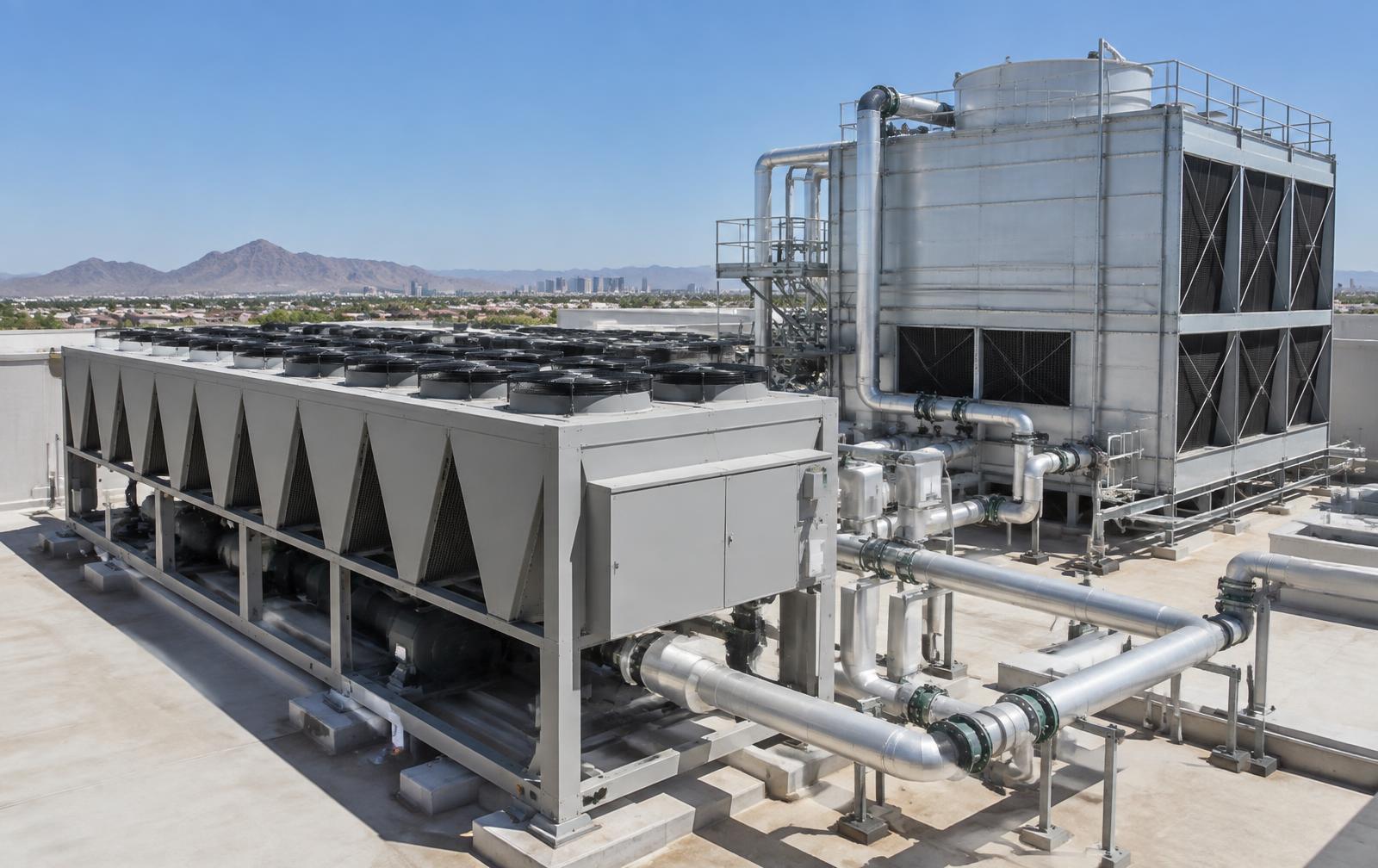
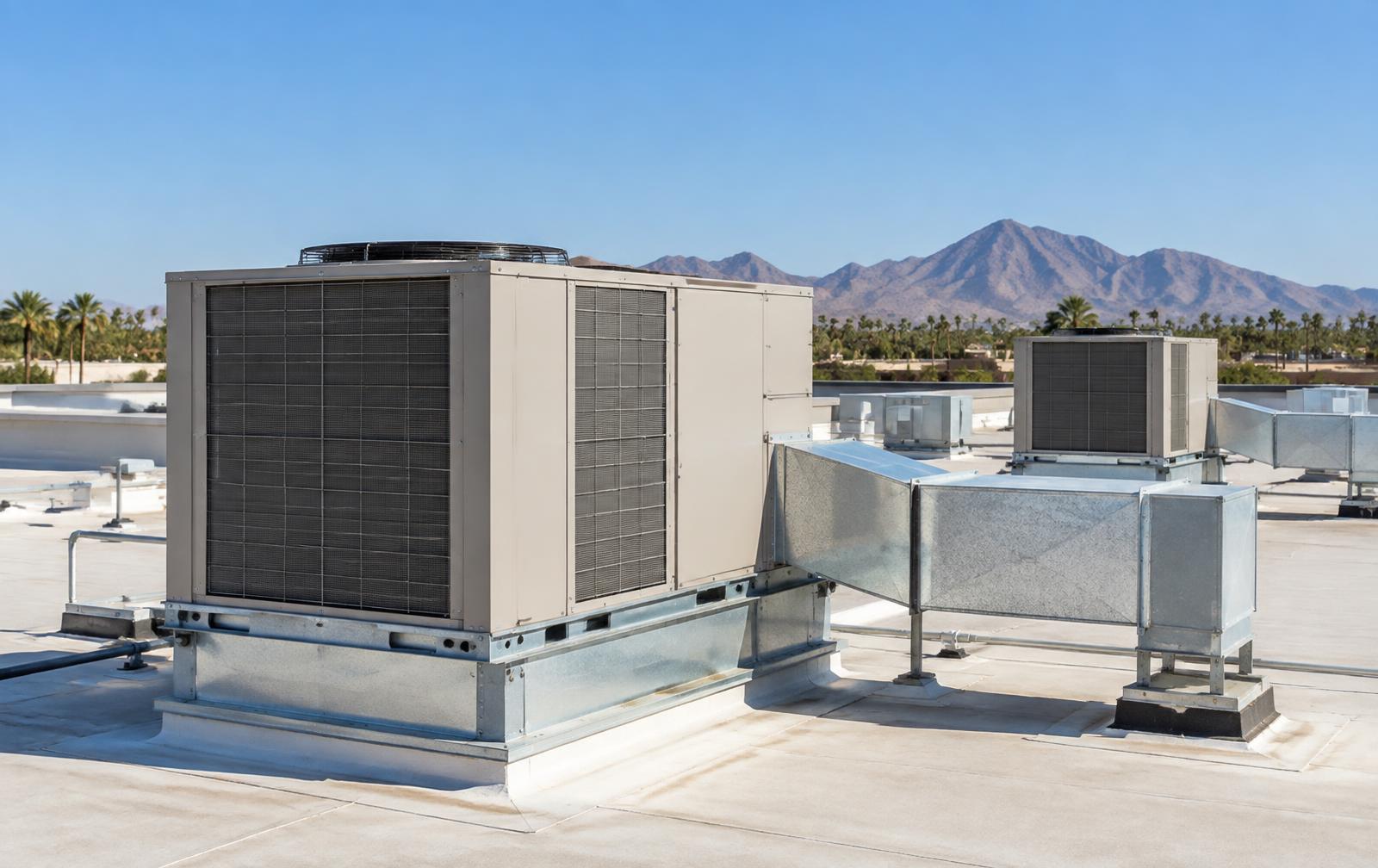
- Rooftop and exterior condensing units reject heat into air that can sit far above design temperature for months.
- What it causes
- High head pressure, longer run times, reduced capacity, and a box that cannot pull down during the hottest part of the day.
Dust, grease, and coil fouling
- The condition
- Desert dust plus kitchen exhaust grease coats condenser and evaporator coils faster here than in most markets.
- What it causes
- An insulating layer on the coil that blocks heat transfer, which mimics a refrigerant problem and burns out compressors that are working fine.
Continuous duty cycle
- The condition
- Coolers and freezers run year round, and in summer they approach continuous operation.
- What it causes
- Compressors, contactors, fan motors, and defrost components accumulate wear hours far faster than nameplate expectations assume.
Door traffic and infiltration
- The condition
- Hot dry air entering a walk-in every time the door opens, plus worn gaskets and closers that never fully seal.
- What it causes
- Moisture load on the evaporator, frost and ice buildup, and a box that runs constantly without ever hitting setpoint.
Power events and voltage stress
- The condition
- Monsoon season brings outages, brownouts, and surges to Valley buildings.
- What it causes
- Failed contactors, start components, and control boards, often showing up days after the storm rather than during it.
In this climate, refrigeration reliability is mostly a heat rejection problem. Keep the condenser clean and the air moving and the majority of emergency calls never happen.
Warning signs, and what each one usually means
Refrigeration rarely fails without notice. It drifts. These are the signals worth a service call while product is still safe, and the conditions each one normally points to.
Box temperature creeping up
- What you see
- The cooler holds a few degrees higher than setpoint, worst in the afternoon.
- Usual causes
- Dirty condenser coil, low refrigerant charge, failing condenser fan motor, or a box that is simply undersized for current load.
Ice on the evaporator or ceiling
- What you see
- Frost on the coil, ice on the fan guards, or a sheet of ice forming inside a freezer.
- Usual causes
- A defrost problem: failed heater, defective termination sensor, bad timer or control, or heavy infiltration through a bad door seal.
The unit never shuts off
- What you see
- Compressor running continuously with no cycling, even at night.
- Usual causes
- Loss of capacity from fouling or charge, a leaking door gasket, a stuck contactor, or a control calling constantly because the box cannot reach setpoint.
Water on the floor
- What you see
- Pooling under the evaporator, at the door, or near the condensate line.
- Usual causes
- Blocked or frozen condensate drain, failed drain line heater on a freezer, or melt from a defrost cycle that is not draining as designed.
New noise or vibration
- What you see
- Grinding, rattling, or a hum that was not there last week.
- Usual causes
- Fan motor bearings, a loose blade or shroud, or a compressor under mechanical stress that should be evaluated immediately.
Product quality changes
- What you see
- Freezer burn, condensation on packaging, or inconsistent temperatures across the box.
- Usual causes
- Airflow distribution problems, short cycling, humidity control issues, or a sensor reading a location that does not represent the box.
None of these are emergencies on the day they appear, and all of them become emergencies if nothing happens. A logged temperature record makes the drift obvious weeks before a failure does.
What a commercial refrigeration service call should include
A proper refrigeration diagnosis is a measurement exercise, not a parts swap. These are the checks that separate a real diagnosis from a guess.
- 1
Verify the actual box condition
Measure product temperature and air temperature at multiple points rather than trusting a single display. A controller reading and the real box condition are not always the same thing.
- 2
Inspect the condenser and airflow path
Check coil cleanliness, fan operation, clearance around the unit, and whether the condenser is ingesting its own discharge air or heat from adjacent equipment.
- 3
Read system pressures and temperatures
Suction and discharge pressures, superheat, and subcooling together indicate whether the problem is charge, airflow, metering, or compression, before anyone adds refrigerant.
- 4
Evaluate the evaporator and defrost cycle
Coil condition, fan operation, defrost initiation and termination, heater function, and drain flow. Most freezer complaints live in this section.
- 5
Check electrical and controls
Contactors, capacitors, relays, motor amperage against nameplate, sensor accuracy, and controller setpoints and alarm history.
- 6
Inspect the box itself
Door gaskets, closers, hinges, sweeps, strip curtains, and panel condition. An envelope problem will defeat a perfectly healthy refrigeration system.
- 7
Locate leaks rather than topping off
Refrigerant does not get consumed. If a system is low, there is a leak, and repeatedly adding refrigerant is both a recurring cost and a regulatory issue.
- 8
Document findings
Readings, photos, parts installed, and recommendations in writing, so the next visit starts with history instead of starting over.
Adding refrigerant without finding the leak is not a repair. It is a scheduled return visit at the customer's expense.
Equipment we see across Valley businesses
Commercial refrigeration covers a much wider range of equipment than most facility budgets account for, and each type carries its own failure profile.
Walk-in coolers and freezers
The highest-value boxes in most restaurants, grocers, and commissaries. Failures concentrate in condensing units, defrost systems, and door hardware.
Reach-in coolers, freezers, and prep tables
Self-contained units that live in hot kitchens with limited clearance, which is exactly the environment that fouls condensers fastest.
Refrigerated display cases
Retail and grocery merchandisers where airflow curtains, lighting heat load, and store humidity all affect holding temperature.
Ice machines
High-duty equipment sensitive to hard Valley water. Scale on the evaporator plate reduces production and shortens component life.
Remote condensing units and racks
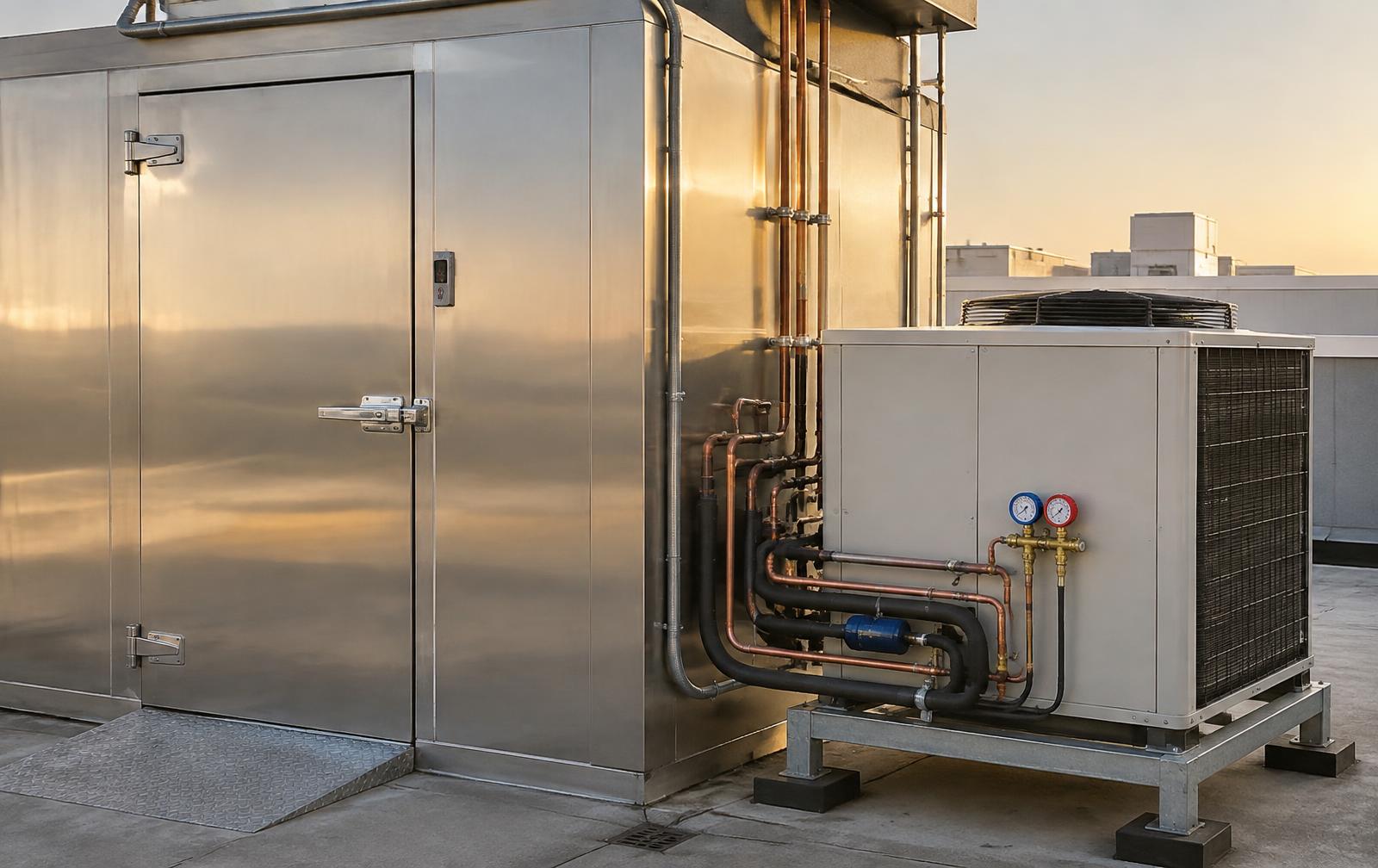
Rooftop or exterior condensers serving one or more boxes, where clearance, ambient conditions, and line set condition drive performance.
Medical and laboratory refrigeration
Applications where temperature stability and documentation matter as much as cooling, because stored materials have strict handling requirements.
Beverage and bar systems
Under-counter and back-bar equipment that runs hard during service hours in tight, warm spaces.
Process and industrial cooling
Equipment cooling and process refrigeration where a shutdown stops production rather than spoiling inventory.
Many Valley operators have refrigeration, HVAC, and plumbing under three separate contracts. Running them under one licensed mechanical contractor removes the finger pointing when a rooftop problem and a refrigeration problem share the same electrical or drainage cause. See our commercial mechanical services and the industries we serve.
Refrigeration maintenance: what actually prevents failures
Refrigeration is the clearest case in the building for preventative maintenance, because the cost of a missed inspection is measured in spoiled inventory rather than in comfort. Frequency should track the environment: a kitchen condenser in a grease-laden space needs attention far more often than a clean back-of-house cooler.
Condenser coil cleaning
The single highest-value task on the list in this climate. A clean coil lowers head pressure, restores capacity, and directly extends compressor life.
Evaporator coil and fan inspection
Coil cleanliness, blade condition, motor amperage, and unobstructed airflow inside the box.
Defrost cycle verification
Confirming initiation, termination, and heater function on every freezer, and adjusting cycles to real conditions rather than factory defaults.
Condensate drain and heater check
Clearing drain lines and verifying drain heaters so defrost water leaves the box instead of freezing in place.
Refrigerant charge and leak inspection
Verifying charge through superheat and subcooling and inspecting joints, valves, and line sets for oil residue that indicates a leak.
Electrical inspection
Contactor contacts, capacitors, terminal tightness, and amperage readings compared against nameplate values.
Door gasket, closer, and sweep service
Cheap parts that control infiltration, frost, and run time. Replacing a torn gasket often fixes what looks like a refrigeration fault.
Controls and temperature logging review
Setpoint verification, sensor calibration, and reviewing alarm and temperature history for drift that has not yet become a complaint.
Written report with recommendations
Documented condition and prioritized repairs so capital planning happens on a spreadsheet instead of during an emergency.
Refrigeration inspections are most efficient when they ride along with the rest of the mechanical schedule. Our preventative maintenance program covers refrigeration alongside HVAC so one visit and one report cover the systems that cause downtime. The same logic we apply to commercial HVAC maintenance applies here with tighter tolerances.
Repair or replace a commercial refrigeration system
When a unit has failed more than once, the decision is not only about the current repair. It is about how much service life is left and what another failure would cost.
Repair makes sense
- When it fits
- An isolated component failure on equipment that is otherwise sound, holding temperature, and within reasonable service life.
- Trade-off
- Lowest immediate cost and fastest return to service, with no change to underlying efficiency.
Component upgrade
- When it fits
- A condensing unit, evaporator, or controller that is undersized or obsolete while the box itself is in good condition.
- Trade-off
- Targeted spend that fixes a recurring failure category without replacing the entire system.
Full replacement
- When it fits
- Repeated failures, a compressor loss on aged equipment, or a system on a refrigerant that is increasingly costly to source.
- Trade-off
- Highest upfront cost and the most coordination, but it resets reliability and usually improves energy performance.
Envelope and door work
- When it fits
- Panels, gaskets, closers, and strip curtains that are letting heat and humidity into an otherwise healthy box.
- Trade-off
- Small spend with an outsized effect on run time, frost, and product quality.
Redesign the installation
- When it fits
- A condenser with inadequate clearance, recirculating its own hot air, or placed where adjacent equipment raises its inlet temperature.
- Trade-off
- Requires planning and access, but it addresses a condition that will keep killing compressors regardless of what gets replaced.
What drives commercial refrigeration repair cost
Every building and every system is different, so a price in an article would be guesswork. The variables behind a quote are consistent, and understanding them makes competing proposals easier to compare.
System type and size
A reach-in, a walk-in with a remote condenser, and a multi-compartment rack are three different scopes of work.
Refrigerant type and quantity
Older refrigerants can be significantly more expensive and harder to source than current alternatives.
Component versus sealed system
Replacing a fan motor or contactor is routine. Opening the sealed system for a compressor or coil is a longer, more involved job.
Access and location
Rooftop placement, tight kitchen clearances, and rigging requirements all add labor.
Leak repair scope
Finding and repairing a leak, evacuating, and recharging is more work than a top-off, and it is the repair that actually holds.
Timing
After-hours and emergency response carries a premium that scheduled work does not.
Parts availability
Obsolete or specialty components can extend both cost and downtime.
The comparison that matters is not repair cost against replacement cost. It is total cost against the value of the product inside the box plus the revenue lost while it is down.
How to choose a commercial refrigeration company
Refrigeration is a specialty inside the mechanical trade, and not every HVAC company is set up for it. These are the things worth confirming before a contractor goes on your approved vendor list.
Proper Arizona licensing
Confirm the contractor is licensed for refrigeration work in the state. Central Mechanical Services holds AZ ROC #325571 (CR-39 HVAC and Refrigeration) and AZ ROC #325622 (CR-37 Plumbing), along with a KB-1 Dual Building Contractor license, and is bonded and insured.
EPA 608 certified technicians
Refrigerant handling is federally regulated. The technician opening a sealed system should hold current EPA Section 608 certification.
Genuine 24/7 response
Refrigeration does not fail during business hours, and an answering service is not a response plan. We provide 24/7 emergency dispatch across the Valley.
Diagnostic discipline
Pressures, superheat, subcooling, amperage, and leak detection as standard practice rather than refrigerant added on every visit.
Experience with your equipment
Restaurant walk-ins, grocery cases, medical refrigeration, and industrial process cooling each carry their own requirements and documentation expectations.
Written documentation
Readings, findings, photos, and recommendations you can file, budget from, and hand to ownership or an inspector.
Maintenance capability, not just repair
A contractor who only shows up when something breaks will never reduce how often things break.
One contractor across mechanical systems
Refrigeration, HVAC, and plumbing under a single licensed contractor means one accountable team when a failure crosses system boundaries.
Central Mechanical Services LLC was founded in 2019 and brings more than 150 years of combined team experience to commercial and industrial mechanical work across Phoenix and the surrounding Valley. If your refrigeration equipment is drifting, icing, or running nonstop, contact our team and we will get eyes on it before it becomes an inventory loss.
Need a Phoenix tech today?
Talk to a real Valley dispatcher - same-day appointments and live answer 24/7.