By the Central Mechanical Services LLC team
Licensed Phoenix mechanical contractor - AZ ROC #325571 & #325622
In this article (8 sections)
- 01Why Phoenix buildings run boilers at all
- 02What an annual boiler service actually covers
- 03What actually fails, and what Arizona does to boilers
- 04Warning signs your boiler needs attention now
- 05Repair or replace
- 06What drives boiler service and replacement cost
- 07Why downtime math favors a service plan
- 08Getting started
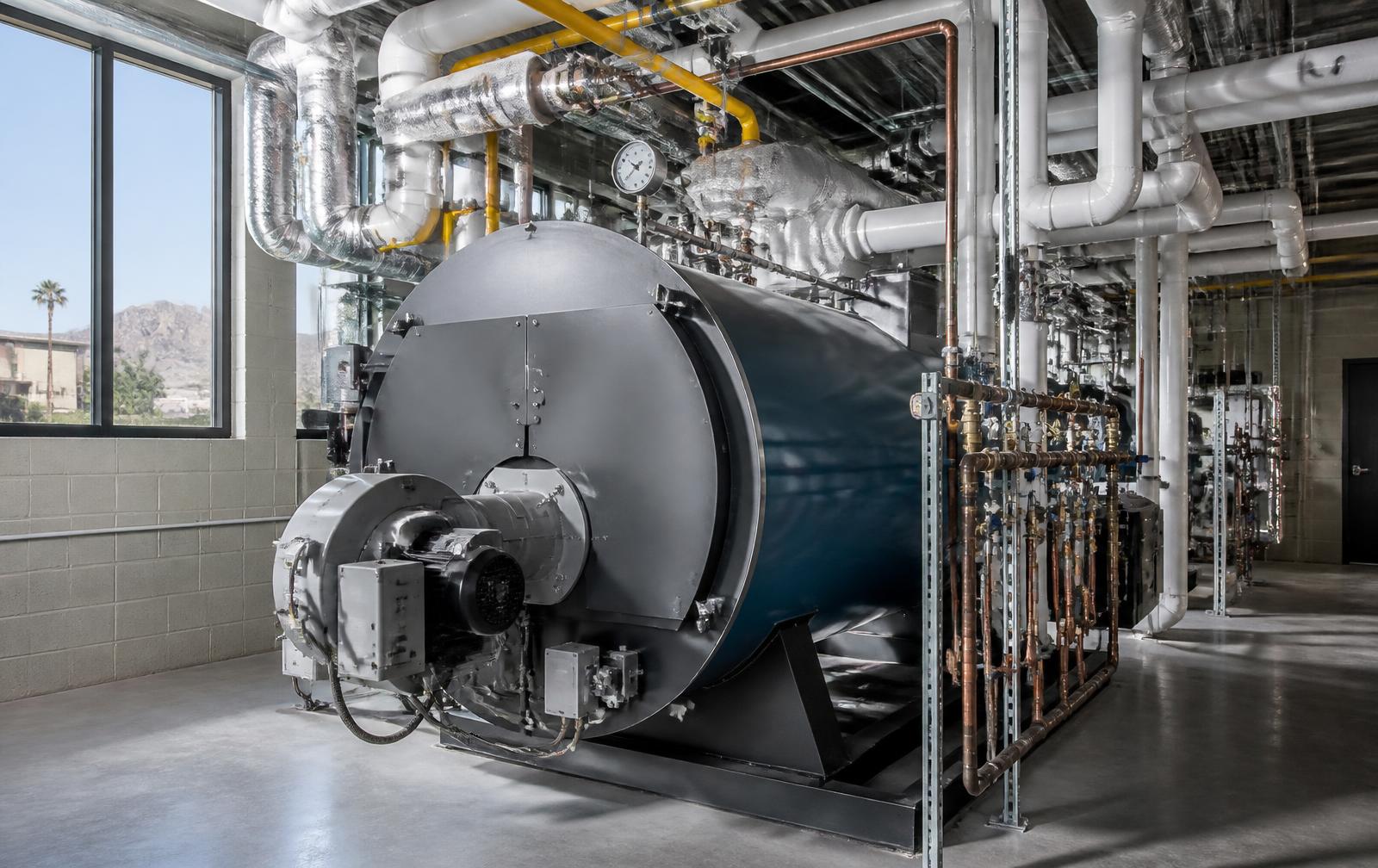
Boilers are the equipment nobody in Phoenix thinks about until the hot water stops. Cooling gets all the attention here, and for good reason, but a surprising number of Valley buildings depend on a boiler every single day of the year: hotels, apartment complexes, hospitals and clinics, schools, restaurants, laundries, and manufacturing plants with process heat loads.
The trouble is that low visibility turns into low maintenance. A boiler that runs quietly in a back mechanical room gets skipped on the service schedule until the day it fails, and boiler failures rarely fail small. This guide, from the commercial team at Central Mechanical Services, covers what a real boiler service includes, what breaks in Arizona conditions, when repair stops making sense, and what drives the price.
Why Phoenix buildings run boilers at all
Domestic hot water is the biggest reason. Any building with significant hot water demand, from a 200 unit apartment complex to a hotel to a commercial kitchen, is almost certainly using a boiler or a bank of them rather than a row of residential tanks.
Process heat is the second. Laundries, food production, breweries, plating shops, and light manufacturing use steam or hot water as an input to the work itself. When that boiler goes down, production stops, which makes the downtime cost far larger than the repair.
Hydronic space heating is the third, and it is more common in the Valley than people expect. Older institutional buildings, campuses, and some high rises heat with hot water loops and fan coils rather than furnaces or heat pumps. Phoenix winters are short, but January mornings at 38 degrees still require a working heating plant.
The practical takeaway: in most Valley buildings the boiler is not a seasonal machine. It is a year round machine with a seasonal peak, and it should be maintained accordingly.
What an annual boiler service actually covers
A real inspection is a half day of work on most commercial units, not a quick visual check. Expect the technician to shut the unit down, open it up, and document readings before and after.
Combustion. Burner cleaning and inspection, flame pattern and ignition check, gas pressure verification, and a combustion analysis with flue gas readings. Combustion tuning alone often recovers a meaningful percentage of fuel efficiency.
Water side. Inspection of the fire tubes or heat exchanger, checking for scale and soot, flushing and blowdown as applicable, and inspecting the condensate system on condensing units.
Safety controls. Testing the low water cutoff, pressure and temperature limits, relief valve, flame safeguard, and gas train components. These are the controls that separate a shutdown from an incident, and they are the ones most often found out of calibration.
Water treatment. Testing loop chemistry, checking for oxygen ingress and pH drift, and verifying that treatment is actually being dosed rather than assumed.
Documentation. Pressures, temperatures, combustion numbers, and a written list of recommended repairs with urgency levels. If you are not getting readings on paper, you are not getting an inspection.
This scope belongs inside a preventative maintenance agreement rather than a one off call, because trending readings year over year is what tells you a heat exchanger is degrading before it fails.
What actually fails, and what Arizona does to boilers
Scale from hard water. Valley water is hard, and hardness is the number one enemy of a boiler. Scale on the water side of a heat exchanger insulates the metal from the water it is supposed to heat, which drives fuel use up and metal temperature up at the same time. A thin scale layer can cost several percent in efficiency, and a thick one cracks tubes. Buildings with no softener or no working treatment program pay for it in fuel every month and in equipment life eventually.
Ignition and flame safeguard faults. Dirty ignitors, drifting flame sensors, and aging flame safeguard controls are the most common cause of nuisance lockouts. They are cheap to fix on a scheduled visit and expensive at 2 a.m.
Low water cutoff problems. Sediment fouls the probe or float, and a low water cutoff that does not trip is the most dangerous condition a boiler can have. This device gets tested on every service visit, without exception.
Condensate corrosion. On condensing boilers, acidic condensate eats through neutralizer media, drain lines, and eventually the heat exchanger if the neutralizer is neglected.
Short cycling from oversizing. Many Phoenix boilers were sized for peak domestic hot water demand and spend most of the year cycling far below capacity. Short cycling multiplies ignition wear and thermal stress. Controls staging and, on multi boiler plants, proper lead lag sequencing solve most of it.
Deferred service between seasons. Because the heating season here is short, boilers often go unserviced for years. The unit runs, so nobody calls. Then a control fails during the one week the building actually needs heat.
Warning signs your boiler needs attention now
Rising gas bills with no change in occupancy or weather. This usually means scale, soot, or combustion drift.
Repeated lockouts or manual resets. A boiler that needs resetting is telling you a safety is tripping for a reason.
Inconsistent hot water at the taps, or complaints that cluster at peak demand hours.
Visible leaks, rust streaks, or white mineral deposits around fittings and the base of the unit.
Banging, kettling, or popping noises, which typically indicate scale or circulation problems.
Soot around the burner or flue, or any evidence of poor draft. Treat combustion and venting issues as urgent.
A relief valve that has discharged. Something drove pressure past the limit, and that cause needs to be found.
If you have a hot water outage or a boiler down in an occupied building, that is an emergency service call, not a next week call.
Repair or replace
A well maintained commercial boiler commonly runs 20 to 30 years, and cast iron sectional units in institutional settings can run longer. Poorly treated water shortens that dramatically, and it is not unusual to see units in untreated Valley systems fail well short of 15 years.
Repair generally makes sense when the pressure vessel and heat exchanger are sound and the fault is in burners, controls, pumps, valves, or the gas train. Those are serviceable components with clear pricing and a long remaining life behind them.
Replacement starts winning when the heat exchanger is cracked or leaking, when scale damage is widespread, when parts availability has become a problem, or when the unit is past 20 years and needing more than one significant repair per year. A useful rule of thumb: if a single repair approaches a third of replacement cost on a unit past 20 years, price the replacement before you authorize the work.
Efficiency belongs in the math too. A 60 to 70 percent efficient older boiler replaced by a modern condensing unit in the 90s can move fuel spend enough to change the payback period, especially in a building with year round domestic hot water load. Ask for the fuel comparison, not just the equipment quote.
Also weigh the redundancy question. Replacing one large boiler with two or three smaller staged units costs more up front, but it gives you partial capacity during a failure and much better part load efficiency in a climate where full load happens rarely.
What drives boiler service and replacement cost
Capacity. BTU input is the primary driver on both service and replacement. A 400,000 BTU domestic hot water boiler and a 3,000,000 BTU steam plant are different projects entirely.
Type. Hot water versus steam, condensing versus non condensing, fire tube versus cast iron sectional. Steam systems carry more inspection scope and more code exposure.
Access. A boiler in a ground floor mechanical room with a roll up door costs less to service or swap than one that has to be cut apart and carried out of a basement or a penthouse mechanical room.
Water condition. Buildings without softening or treatment need more frequent cleaning, and severe scale can turn a routine service into a descaling project.
Code and permitting. Replacement typically brings venting, combustion air, gas piping, and seismic or structural requirements up to current code, and permits and inspections belong in the budget from day one.
Plan frequency and coverage. Annual versus semiannual service, whether water treatment and testing are included, and whether the agreement includes priority response and after hours coverage all move the number.
Get every bid priced against your actual equipment list, and compare what is included before you compare totals. Two boiler service quotes with a large gap between them are usually quoting two different scopes.
Why downtime math favors a service plan
Run the numbers on your own building. A hotel without hot water is comping rooms. An apartment complex without hot water is generating code complaints. A laundry or food plant without steam is sending staff home. Those hours cost more than several years of maintenance.
Planned service also buys parts lead time. When an inspection flags a failing control or a marginal pump, the part gets ordered and installed on a scheduled visit instead of during an outage, when availability and overtime rates both work against you.
The other benefit is budget predictability. A documented inspection history turns capital planning from a guess into a schedule, so a boiler replacement lands in next year's budget rather than in this week's emergency.
For buildings that cannot tolerate an outage, pair scheduled maintenance with 24 hour coverage so a failure at 11 p.m. gets a technician rather than a voicemail.
Getting started
Build the inventory first: make, model, serial, input BTU, fuel, install year, and location for every boiler, plus what each one serves. Note whether the building has a working softener and an active water treatment program, because that single answer predicts most of what we will find.
Then schedule an inspection ahead of the heating season rather than during it. Late summer and early fall are the right window in Phoenix, when the shop is not yet booked with no heat calls and there is time to order parts.
Central Mechanical Services is a licensed Phoenix mechanical contractor working on boilers, chillers, rooftop units, and full mechanical systems across the Valley, for commercial, industrial, and institutional buildings. If you want a boiler assessment or a service agreement priced against your equipment list, contact our team and we will walk the mechanical room with you.
Need a Phoenix tech today?
Talk to a real Valley dispatcher - same-day appointments and live answer 24/7.