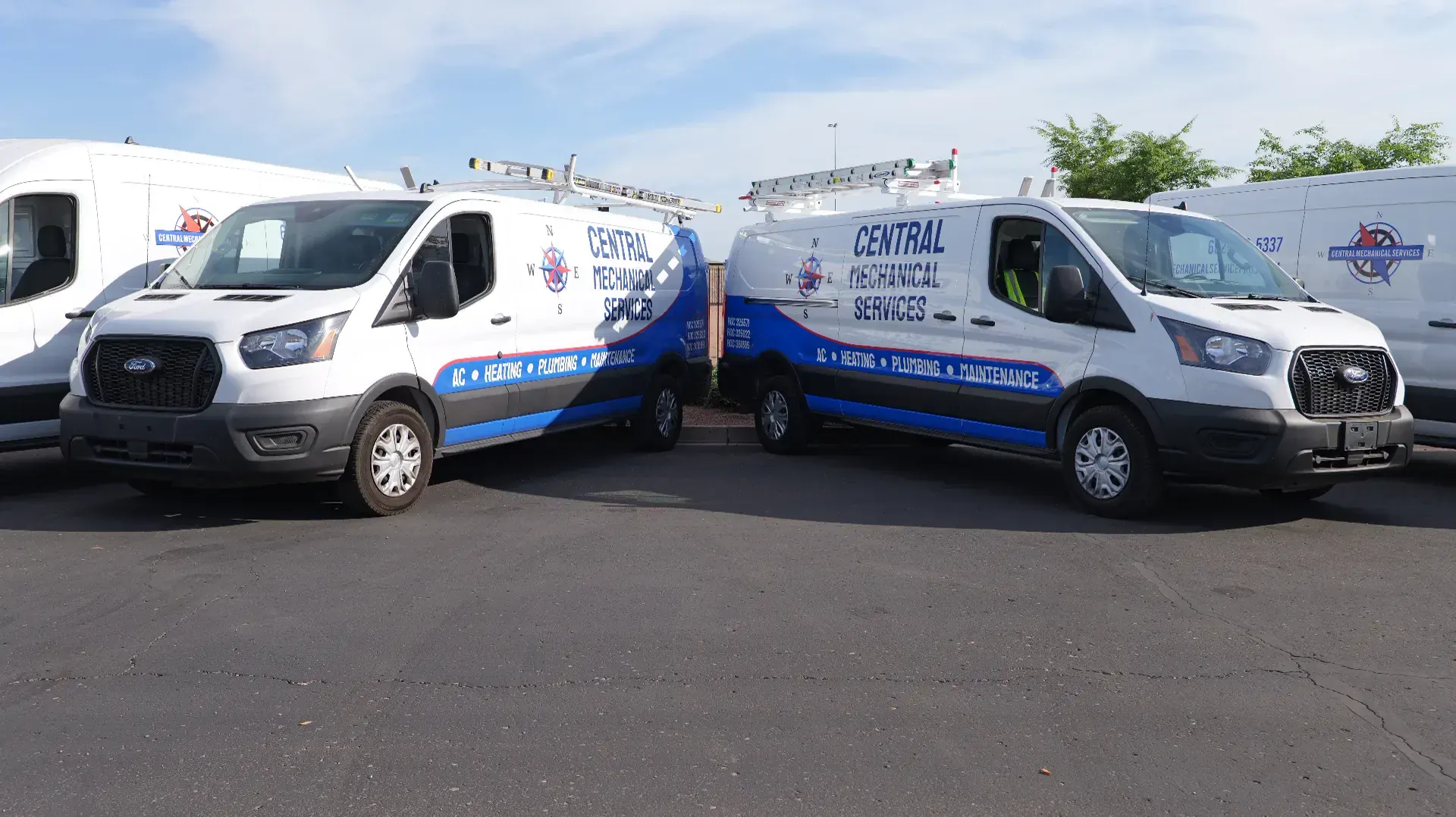
By the Central Mechanical Services LLC team
Licensed Phoenix mechanical contractor - AZ ROC #325571 & #325622
The short version
- Commercial plumbing is judged on uptime, not just repair quality. A failure closes restrooms, kitchens, or an entire tenant space.
- Most emergencies in Valley buildings trace back to drain and grease lines, backflow assemblies, water heaters and recirculation loops, and scale accumulation.
- Camera scoping turns a guess into a measured diagnosis before anyone opens a wall, a ceiling, or a slab.
- A real maintenance scope is scheduled, documented, and tied to the building's occupancy and fixture load.
- Verify the contractor's license classification, insurance, after-hours coverage, and documentation practices before an emergency forces the choice.
In this article (9 sections)
- 01How commercial plumbing differs from residential
- 02What breaks most in Valley commercial buildings
- 03Diagnostics: camera scoping and pressure testing
- 04What a real preventative plumbing scope covers
- 05Emergencies: what to expect and how to prepare
- 06Repair, reroute, or repipe
- 07What drives commercial plumbing cost
- 08How to vet a commercial plumbing contractor
- 09Bringing plumbing into the building's mechanical plan
Commercial plumbing is the same trade as residential plumbing in the way commercial HVAC is the same trade as a home air conditioner: the physics match, and almost nothing else does. Pipe is larger, runtime is constant, fixtures are used hundreds of times a day, code requirements are stricter, and a single failure can close a restroom bank, shut a kitchen, or flood a tenant suite that someone else is paying rent on.
This guide covers what commercial plumbing actually includes in a Phoenix building, the failures that cause the most downtime here, how professional diagnostics narrow a problem down before anything gets opened up, what a serious maintenance scope looks like, and how to vet a contractor before an emergency makes the decision for you. Central Mechanical Services LLC is a Phoenix mechanical contractor licensed under AZ ROC #325622 (CR-37 Plumbing) and AZ ROC #325571 (CR-39 HVAC and Refrigeration), holds a KB-1 Dual Building Contractor license, and is bonded and insured, with a master plumber on staff leading commercial and residential plumbing work across the Valley.
How commercial plumbing differs from residential
The differences are not cosmetic. They change how a system is designed, how it fails, and how it should be maintained.
Load and duty cycle
- Residential
- A handful of fixtures used intermittently by a few people.
- Commercial
- Fixture banks cycled continuously through business hours, often by hundreds of users, with peaks that stress supply and drainage at the same moment.
Pipe sizing and system design
- Residential
- Small-diameter supply and drain lines on short, simple runs.
- Commercial
- Larger mains, longer horizontal runs, multi-story stacks, recirculation loops, and grease waste separated from sanitary waste.
Code and inspection
- Residential
- Standard residential plumbing code and permitting.
- Commercial
- Occupancy-driven fixture counts, backflow protection requirements, grease interception, and inspection obligations that follow the building rather than the owner.
Cost of failure
- Residential
- Inconvenience, property damage, and a repair bill.
- Commercial
- Closed restrooms, a shuttered kitchen, lost revenue, tenant claims, and in some occupancies a health or licensing issue.
Access and scheduling
- Residential
- Work happens whenever the homeowner is available.
- Commercial
- Work is scheduled around occupancy, tenants, and operating hours, which pushes a lot of it to nights and weekends.
In a commercial building, the plumbing question is rarely just "can this be fixed?" It is "how do we fix this without closing the space?"
What breaks most in Valley commercial buildings
Different building types fail in different ways, but the same handful of systems generate most emergency calls across offices, restaurants, retail, industrial space, and medical facilities.
Grease and kitchen waste lines
Food service lines accumulate fats, oils, and grease on the pipe wall until flow restricts and the line backs up, usually at the worst possible hour. Grease interceptors that are undersized or not serviced on schedule accelerate the problem downstream.
Main and branch drain blockages
Long horizontal commercial runs give debris, paper products, and scale a place to collect. Repeat blockages in the same location usually indicate a defect in the line, not user behavior.
Backflow prevention assemblies
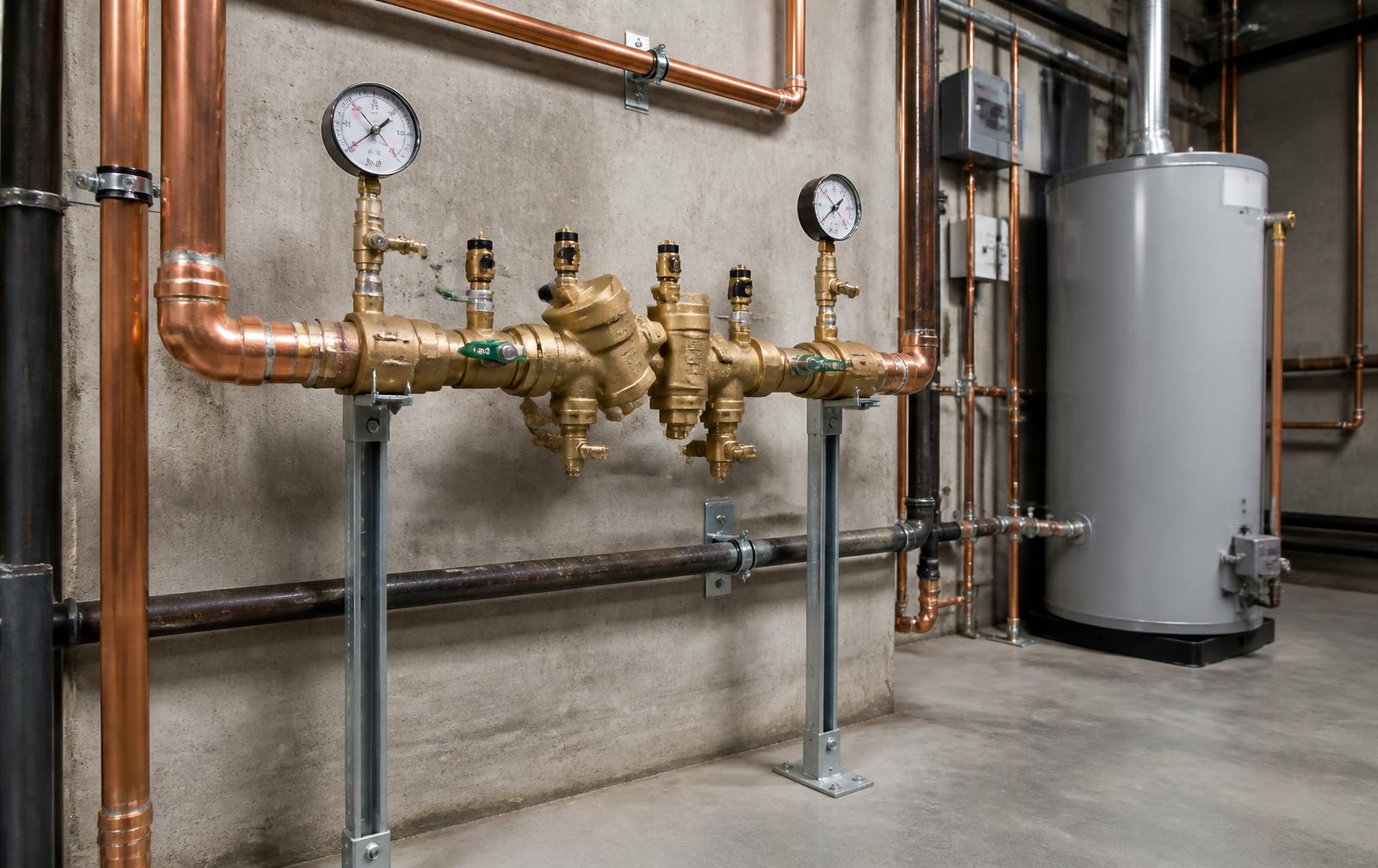
These protect the potable supply from contamination and are a required part of many commercial systems. They contain internal check valves and relief components that wear, and they need periodic testing to confirm they still function.
Commercial water heaters and recirculation loops
High-demand hot water systems run far harder than residential units. Loop pumps, mixing valves, thermostats, and tank components all wear, and a failure means no hot water for the whole building rather than one bathroom.
Scale accumulation on the hot side
Valley water is hard, and hardness precipitates out as scale most aggressively where water is heated. Scale reduces heater efficiency, narrows small-diameter lines, and shortens the life of valves and fixture trim.
Restroom fixtures and flush valves
Flushometers, sensor faucets, and their solenoids and diaphragms are high-cycle components. Individually minor, collectively they drive a steady stream of service calls and water waste.
Roof drains and storm water paths
Monsoon rain arrives fast. Blocked roof drains and overflow paths turn a storm into standing water on a roof, which is a structural and interior-damage problem before it is a plumbing one.
Underground and under-slab supply lines
Buried lines fail out of sight, and the first sign is often a rising water bill or unexplained moisture. Our slab leak guide walks through how those leaks are located and repaired, and the same detection logic applies in commercial buildings.
Diagnostics: camera scoping and pressure testing
The expensive mistake in commercial plumbing is opening the wrong thing. Concrete, ceilings, tenant finishes, and occupied space all cost money to disturb, so the diagnostic step earns its keep.
Video line scoping puts a camera inside the drain line and shows what is actually there: grease buildup, root intrusion, a bellied section holding water, offset joints, a collapsed segment, or a foreign object. That distinction matters because a line that keeps blocking because of a structural defect will keep blocking no matter how many times it is cleared. A camera turns a recurring service call into a scoped repair.
On the supply side, isolation and pressure testing establish whether the system is holding. Sections are isolated and monitored so a loss can be attributed to a specific branch instead of the building as a whole. Acoustic and electronic leak detection then narrows the location before anything is cut. Our team runs camera-verified diagnostics precisely so the repair scope is based on what the line looks like rather than what the symptom suggests.
Documentation is part of the deliverable. Footage, findings, and locations give a facility manager something to attach to a work order, a budget request, or a conversation with ownership.
What a real preventative plumbing scope covers
Most commercial plumbing emergencies are preceded by warning signs that nobody was scheduled to look for. A maintenance scope is what converts those signs into planned work. Frequency should follow occupancy and fixture load, so a restaurant is not on the same interval as a low-traffic office.
Drain and waste line service
Scheduled clearing and periodic camera inspection of kitchen, main, and problem lines, with findings recorded so trends are visible over time.
Grease interceptor verification
Confirming service intervals are adequate for actual volume, and that the interceptor is sized and functioning for the kitchen it serves.
Water heater and hot water loop inspection
Checking combustion or heating elements, safety devices, mixing valve setpoints, recirculation pump operation, and evidence of scale or sediment.
Backflow assembly testing
Periodic testing and documentation to confirm the assembly still protects the potable supply, per the requirements applicable to the building.
Fixture and flush valve audit
Identifying continuously running or leaking fixtures, worn diaphragms, and failing sensors, which quietly waste a meaningful amount of water.
Shutoff and isolation valve exercise
Confirming that isolation valves actually close. A frozen main shutoff turns a small leak into a building-wide event.
Pressure and supply check
Verifying incoming pressure and regulator performance, since excessive pressure shortens the life of everything downstream.
Roof drain and storm path clearing
Timed ahead of monsoon season so drains and overflows are open before the first heavy storm.
Written documentation
A record of what was inspected, what was found, and what is recommended, so deferred items become budget line items instead of surprises.
Plumbing maintenance is easiest to justify when it rides along with the mechanical schedule the building already has. Combining it with an HVAC preventative maintenance program means one visit, one contractor, and one report covering the systems that actually cause downtime.
Emergencies: what to expect and how to prepare
Commercial plumbing failures do not respect business hours, and the difference between a bad hour and a bad week is usually preparation. These steps make the response faster whether or not we are the contractor who takes the call.
- 1
Know where the shutoffs are
Main building shutoff, tenant-level isolation, water heater isolation, and irrigation. Label them, and make sure the after-hours staff on site knows where they are without a search.
- 2
Confirm the valves work before you need them
A shutoff that has not moved in a decade may not close. Exercising valves during scheduled maintenance is the cheapest insurance in the building.
- 3
Stop the water, then stop the damage
Isolate the smallest section that stops the flow, then protect equipment, stock, and finishes while help is on the way.
- 4
Document immediately
Photos and timestamps taken before cleanup starts matter later for insurance, tenant claims, and ownership reporting.
- 5
Call a contractor who already knows the building
A contractor with existing service history, drawings, and camera footage arrives with context. That context is the difference between diagnosing on site and diagnosing from scratch.
The best time to choose an emergency plumbing contractor is on a normal Tuesday, not at 2 a.m. with water moving across a floor.
Repair, reroute, or repipe
When a commercial line fails repeatedly, the real question is which scope of work fits the building, its remaining service life, and its tolerance for disruption.
Spot repair
- When it fits
- An isolated failure on a line that is otherwise in sound condition, with reasonable access.
- Trade-off
- Fastest and least disruptive, but it does nothing for the rest of a line that is failing from age or corrosion.
Reroute
- When it fits
- A buried or inaccessible section where abandoning the old run and routing a new line through accessible space is cheaper than reaching the original.
- Trade-off
- Avoids major demolition, but the new route has to be planned around structure, finishes, and future access.
Partial or full repipe
- When it fits
- Repeated failures across multiple sections, or piping at the end of its service life.
- Trade-off
- The largest scope and the most coordination with occupancy, but it resets the system rather than chasing it.
Drain line rehabilitation
- When it fits
- Waste lines with buildup, minor defects, or joint issues confirmed on camera.
- Trade-off
- Cleaning and repair can extend the line considerably, but a collapsed or bellied section eventually needs replacement.
Equipment replacement
- When it fits
- Water heaters, pumps, or interceptors that are undersized or past service life.
- Trade-off
- Higher upfront cost, but right-sizing usually removes an entire recurring failure category.
What drives commercial plumbing cost
Pricing varies too much by building to quote in an article, but the variables are consistent. Knowing them makes proposals easier to compare.
Access
Whether the work is in an open mechanical room or behind finished ceilings, walls, or concrete.
Pipe size and material
Larger diameter and specialized materials cost more in both material and labor.
Scope of the failure
One fitting versus a run, a branch, or a full system.
Occupancy constraints
Night, weekend, and phased work to keep a space open costs more than open access during the day.
Permitting and inspection
Commercial work frequently requires permits and inspection, which adds time to the schedule.
Restoration
Cutting concrete, ceilings, or finishes brings restoration work with it.
Emergency versus planned
After-hours emergency response carries a premium that scheduled work does not.
This is the strongest financial argument for maintenance. Planned work is scheduled during normal hours, scoped in advance, and budgeted, while the same repair discovered as an emergency is none of those things.
How to vet a commercial plumbing contractor
Commercial work is not a scaled-up version of residential service, and not every plumbing company is set up for it. These are the things worth confirming before a contractor is on your approved list.
License classification
Confirm the contractor holds the appropriate Arizona ROC license for the work. Central Mechanical Services holds AZ ROC #325622 (CR-37 Plumbing) and AZ ROC #325571 (CR-39 HVAC and Refrigeration), plus a KB-1 Dual Building Contractor license.
Bonded and insured
Ask for current certificates. In commercial work the exposure is not only your property but your tenants'.
Genuine after-hours coverage
Confirm that emergency service is staffed rather than an answering service that leaves a message for morning. We provide 24/7 emergency dispatch across the Valley.
Diagnostic capability
Camera scoping, leak detection, and pressure testing should be standard practice, not an upsell requested after the third repeat visit.
Documentation practices
Written findings, photos, and footage that you can file, budget from, and hand to ownership.
Experience with your building type
Kitchens, medical facilities, industrial space, and multi-tenant offices each carry their own requirements. Ours spans the industries we serve across the Valley.
Mechanical scope under one contract
A contractor licensed for both plumbing and HVAC can cover the building's mechanical systems under one relationship, which removes the finger-pointing that happens when a problem sits between two trades.
Bringing plumbing into the building's mechanical plan
Plumbing is often the last system to get a maintenance plan and the first to cause an unplanned closure. In practice the two systems overlap constantly: condensate lines tie into drainage, hot water loops share mechanical space with boilers, and the same scale chemistry that shortens a water heater's life is at work in heat exchangers.
Treating plumbing as part of the building's mechanical program rather than a separate reactive service is what turns emergencies into scheduled work. That means one inspection calendar, one set of documentation, and one contractor accountable for the systems that keep the building open. Our commercial mechanical services cover HVAC, plumbing, chillers, boilers, and rooftop units under a single contract for exactly that reason.
If your building is running plumbing reactively right now, the starting point is simple: a walkthrough, a camera look at the lines that have caused trouble before, and a written scope. Contact our team or call to schedule one.
Need a Phoenix tech today?
Talk to a real Valley dispatcher - same-day appointments and live answer 24/7.