By the Central Mechanical Services LLC team
Licensed Phoenix mechanical contractor - AZ ROC #325571 & #325622
In this article (8 sections)
- 01Why Phoenix commercial systems fail differently
- 02What a real commercial maintenance plan covers
- 03Rooftop units: the workhorse of Valley buildings
- 04Chillers, boilers, and split systems
- 05What drives the cost
- 06Planned versus reactive: the real math
- 07How to choose a Phoenix mechanical contractor
- 08Getting started
Commercial HVAC in Phoenix does not fail the way home equipment does. It fails on a Tuesday afternoon in July, in a building full of tenants, employees, patients, or inventory, and the cost of that hour is never just the repair invoice.
This guide is written for facility managers, property managers, and building owners in the Valley. It covers what a real commercial maintenance plan includes, how the scope changes by equipment type, what actually drives the price, and how to tell a serious mechanical contractor from a filter swap outfit. It comes from the field team at Central Mechanical Services, a licensed Phoenix mechanical contractor working on commercial, industrial, and institutional systems across the Valley.
Why Phoenix commercial systems fail differently
Runtime is the first factor. A rooftop unit serving an office or retail space in Phoenix runs most of the year, and through the summer it may never fully cycle off during business hours. Bearings, belts, motors, and compressors accumulate wear on a schedule that has little in common with a mild climate.
Ambient temperature is the second. When rooftop air is 115 degrees, condensers reject heat into air that is already near the limits of the equipment design. Head pressure climbs, amp draw climbs, and marginal components fail early rather than gracefully.
Dust and monsoon debris are the third. Valley dust cakes condenser coils and loads filters far faster than manufacturer intervals assume. A coil that looks slightly dirty can cost you a measurable share of capacity and a lot of energy.
Add roof heat, UV degradation of wiring and insulation, and hard water in humidification and boiler loops, and you get equipment that rewards planned service and punishes neglect quickly.
What a real commercial maintenance plan covers
A serious plan is scoped in writing, tied to an equipment list, and performed on a schedule. Ask for the task list before you sign anything.
Every visit should include: filter inspection and replacement on the specified schedule, belt condition and tension, motor and bearing inspection, condensate pan and drain clearing, electrical connection tightening, contactor and capacitor testing, amp draw readings, refrigerant pressure and superheat or subcooling readings, thermostat and control verification, and a written report with readings recorded.
Seasonal work should include: full condenser and evaporator coil cleaning before cooling season, economizer damper and actuator testing, heat exchanger inspection before heating season, safety control testing, and airflow verification.
Annual work should include: a documented equipment condition assessment, remaining useful life notes on major components, and a capital planning summary so budget conversations are not guesswork.
Most Valley buildings are best served by quarterly visits. Restaurants, kitchens, medical suites, high dust industrial spaces, and anything with a high filter load usually need monthly or bimonthly filter service between full visits.
Rooftop units: the workhorse of Valley buildings
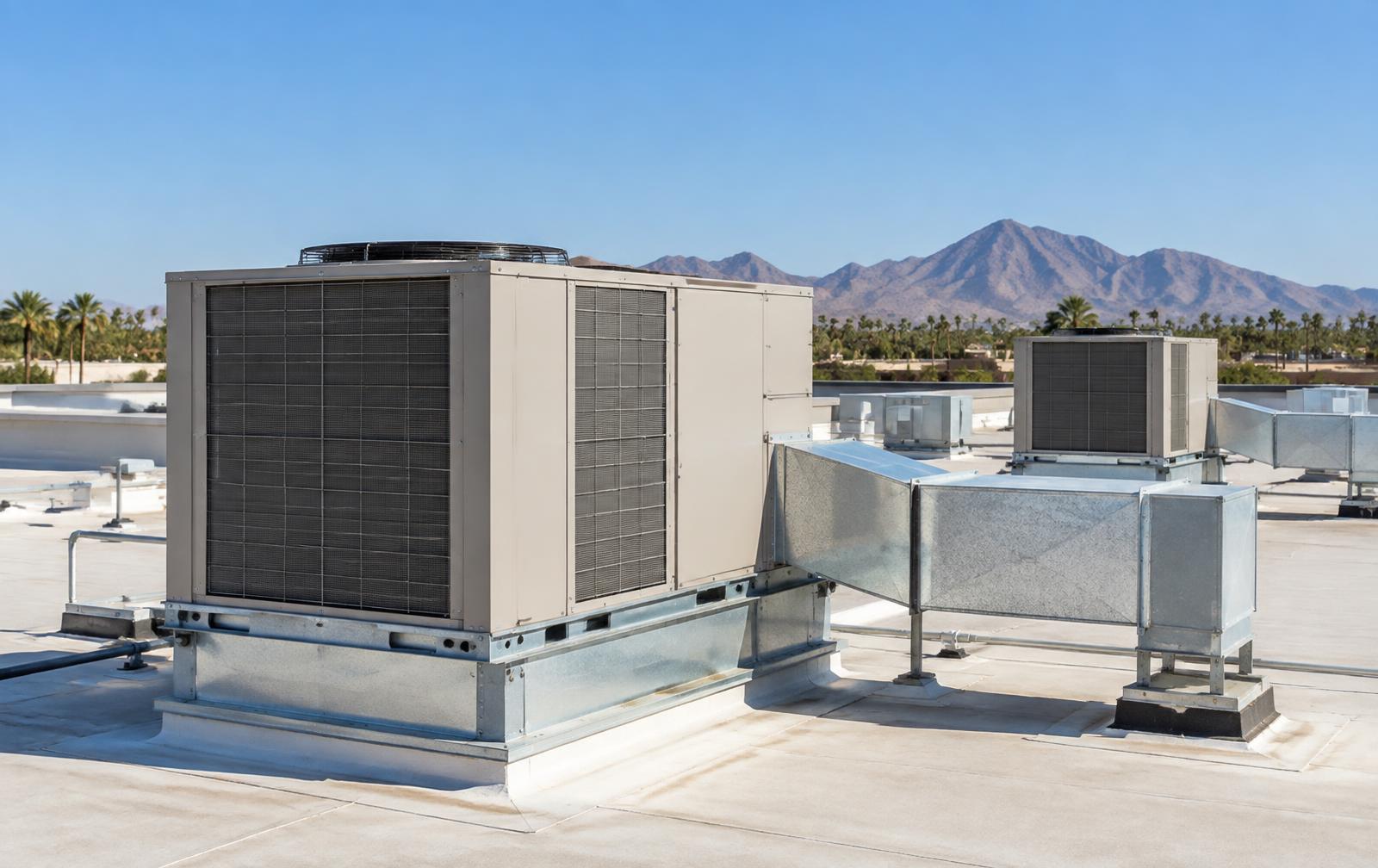
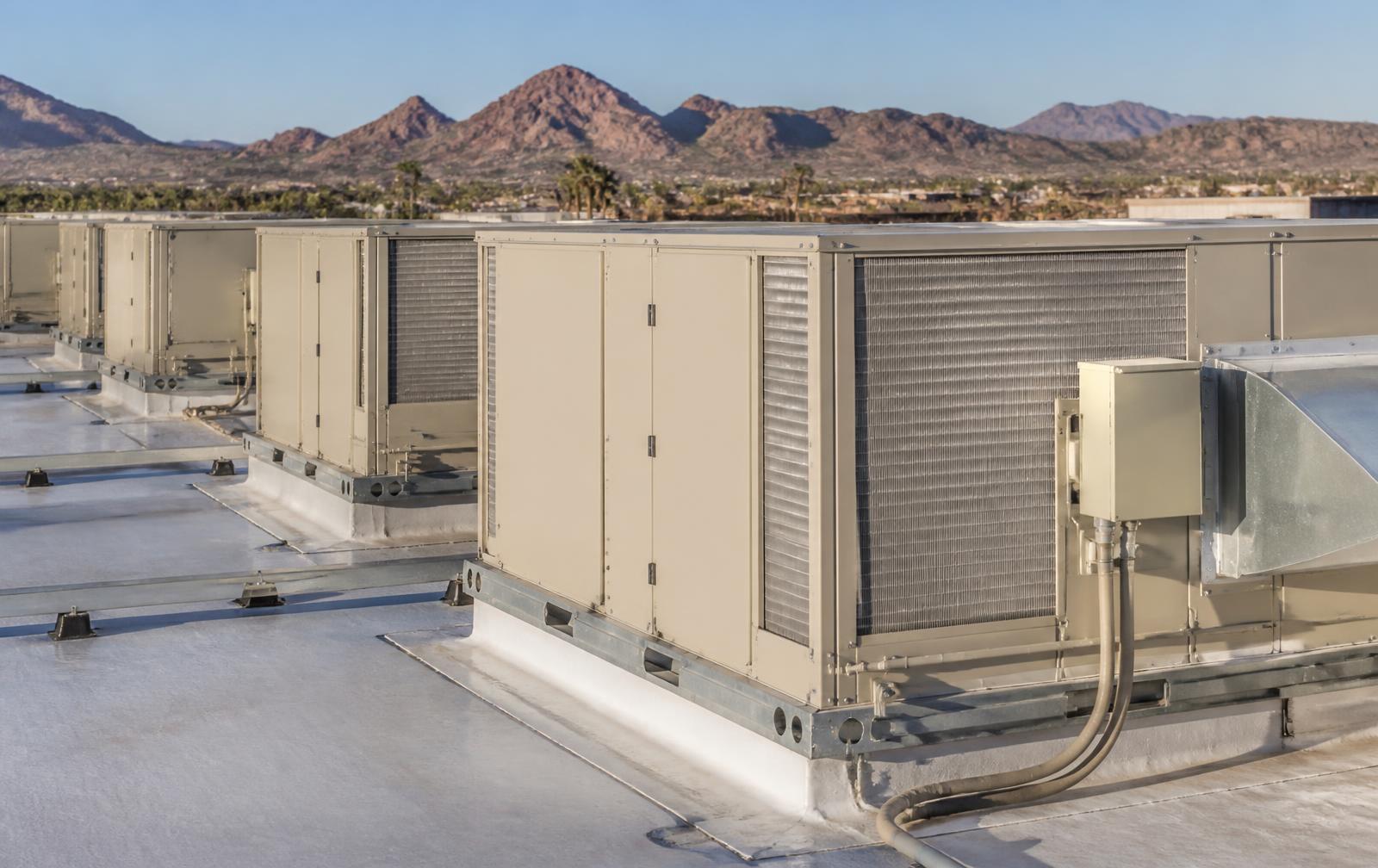
Most Phoenix commercial buildings run packaged rooftop units, commonly called RTUs. They combine compressor, condenser, evaporator, and often gas heat in a single cabinet on the roof, which is convenient for service and brutal on components sitting in direct sun.
The parts we replace most on Valley RTUs are run capacitors, contactors, belts, condenser fan motors, and economizer actuators. All of those are inexpensive when caught during a scheduled visit and expensive when they take a unit down in August.
Two RTU items get skipped constantly. The first is the economizer, which brings in outside air when conditions allow and quietly wastes energy when the actuator fails. The second is the condensate drain, which backs up and floods ceilings when it is not cleared.
Typical RTU service life in Phoenix is 12 to 18 years with consistent maintenance, and noticeably less without it.
Chillers, boilers, and split systems
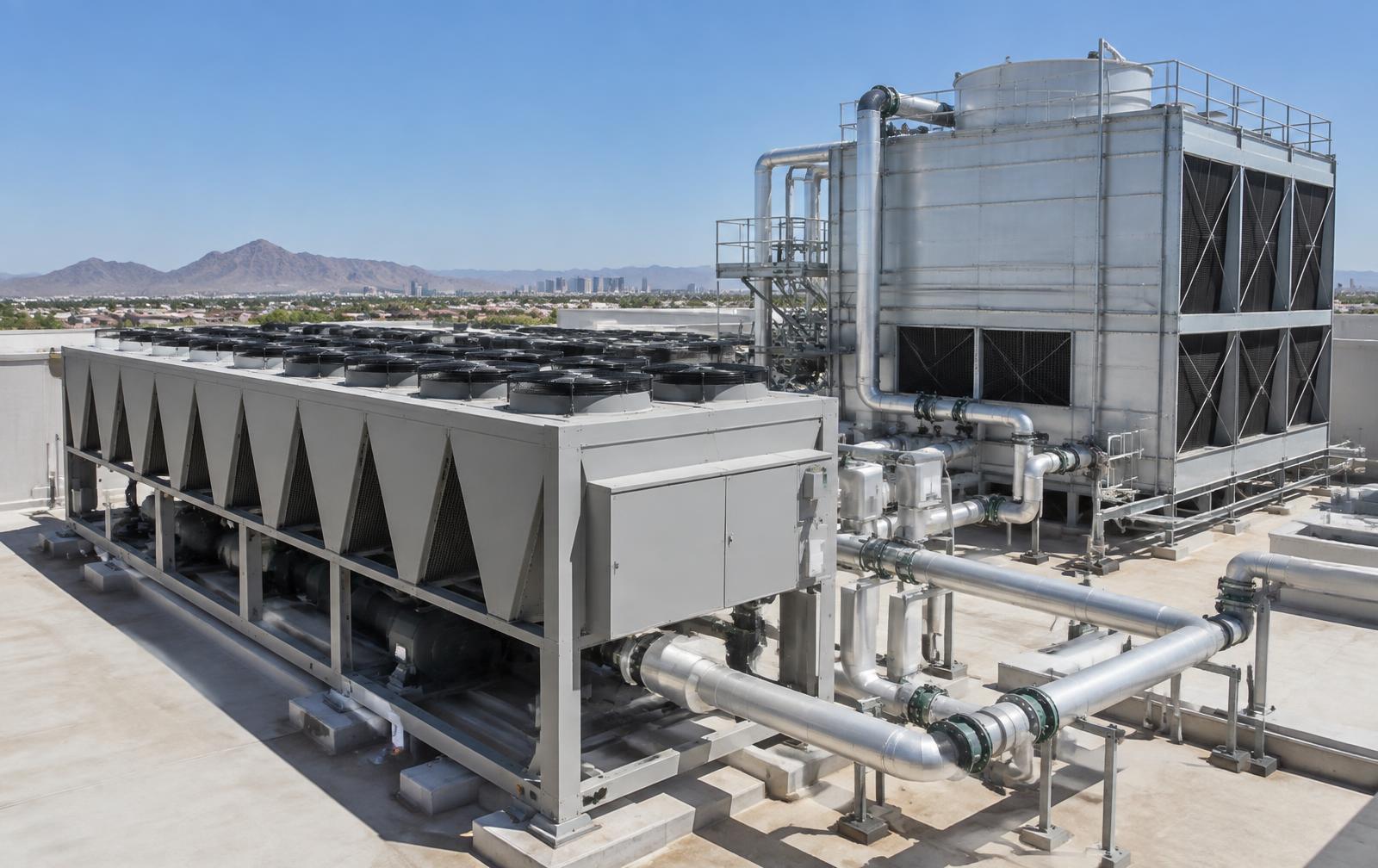
Chillers demand a different discipline. Water treatment, tube cleaning, log readings, refrigerant management, and pump and cooling tower service all belong in the scope. Skipping water treatment is the fastest way to lose efficiency and eventually tubes.
Boilers need combustion analysis, safety and limit control testing, low water cutoff testing, scale and water quality management, and relief valve verification. In Phoenix, hard water makes scale control the recurring theme.
Ductless and split systems in offices, server rooms, and tenant suites are often forgotten because they are quiet. Server room and equipment room units deserve priority in the plan because their failure has consequences well beyond comfort.
Controls tie all of it together. Bad sensors, overridden setpoints, and forgotten schedules routinely cost more than a mechanical fault, and they are invisible unless someone checks.
What drives the cost
Commercial maintenance is priced from a handful of variables. Nationally, plans commonly land between roughly $250 and $600 per rooftop unit per year for quarterly service, with wide movement in either direction. Ask any bidder to price your specific equipment list rather than a per building guess.
Unit count and tonnage. More units and larger tonnage mean more labor and more consumables.
Visit frequency. Quarterly is the common baseline. Monthly filter service adds cost but is the right call for high dust and high load spaces.
Filter type. A standard pleated filter and a MERV 13 or hospital grade filter are very different line items, especially at volume.
Roof access. Ladder access, lift requirements, tie off needs, and after hours access all change labor time.
Equipment type and age. Chillers and boilers carry more specialized labor than packaged rooftop units. Older equipment needs more time.
Scope of inclusions. Some plans include coil cleaning, refrigerant, and priority emergency response. Others bill each separately. Compare inclusions before comparing prices, because the cheapest agreement is usually the thinnest one.
Planned versus reactive: the real math
The maintenance invoice is the small number. The numbers that matter are downtime, energy, and equipment life.
Downtime. A failed rooftop unit over a retail floor or a dining room in July is lost revenue per hour, not a repair line item. In a medical or lab setting it can mean cancelled appointments or compromised materials.
Energy. Dirty coils, restricted airflow, low refrigerant charge, and failed economizers all raise consumption. Cooling is a dominant share of a Phoenix building's energy bill, so a few points of lost efficiency across a bank of units adds up fast.
Equipment life and emergency premiums. Deferred maintenance pushes replacement forward by years, and emergency work costs more per hour than planned work while giving you no scheduling control.
There is also a documentation benefit that facility managers feel at budget time. A maintenance file with readings and condition notes turns a capital request into a defensible plan rather than a surprise.
How to choose a Phoenix mechanical contractor
Verify licensing. In Arizona, ask for the ROC license numbers and confirm the classifications match the work. Central Mechanical Services holds AZ ROC #325571 CR-39 for HVAC and refrigeration, AZ ROC #325622 CR-37 for plumbing, and a KB-1 dual building contractor license, and is bonded and insured.
Ask about emergency response. Get the stated response time in writing and ask whether plan customers get priority. Twenty four hour dispatch matters most in the months when everyone needs help at once.
Ask for the reporting format. You should receive readings, photos where relevant, and a clear list of recommended repairs with urgency levels after each visit.
Ask whether the same techs return to your building. Familiarity with your equipment reduces diagnostic time on every future call.
Ask about breadth. Buildings rarely need only HVAC. A contractor who also handles plumbing and general mechanical work removes the coordination burden of managing multiple vendors, which is the model we run on the commercial services and preventative maintenance side of our business.
Getting started
Start with an equipment inventory. Make and model, serial, tonnage, install year, location, and filter sizes for every unit. If you do not have it, a walkthrough builds it.
Then get the scope priced against that list, decide frequency by space type, and set the first visit before the season that stresses your equipment most.
If you manage a building in Phoenix, Scottsdale, Mesa, Tempe, Chandler, Gilbert, Glendale, or anywhere else in the Valley, our team can walk the roof, inventory the equipment, and put a written maintenance scope in front of you. Call (602) 799-5337 or use the contact page to schedule a site assessment.
Need a Phoenix tech today?
Talk to a real Valley dispatcher - same-day appointments and live answer 24/7.