By the Central Mechanical Services LLC team
Licensed Phoenix mechanical contractor - AZ ROC #325571 & #325622
In this article (7 sections)
Most HVAC failures in the Valley are not surprises. They are deferred tasks. A filter that went three months past change, a condenser coil packed with dust from a nearby lot, a contactor with pitted points that nobody looked at in the spring. By the time the call comes in, it is 112 degrees, the building is warm, and a fifteen dollar part has turned into an emergency service ticket.
This is the working checklist our team uses as a starting point on preventative maintenance visits in Phoenix, organized the way it should actually be scheduled: monthly, quarterly, and annually. It applies to commercial rooftop units and to residential split systems, with notes where the two diverge. Central Mechanical Services LLC is a Phoenix mechanical contractor licensed under AZ ROC #325571 (CR-39 HVAC and Refrigeration) and AZ ROC #325622 (CR-37 Plumbing), and our field crews include NATE-certified technicians and EPA 608 certified refrigerant handlers.
Why the Phoenix schedule is different
Standard national maintenance intervals assume a cooling season of four or five months. Ours runs closer to eight, and the shoulder months still pull load. Equipment here accumulates run hours at a rate that makes a once-a-year visit genuinely inadequate for commercial gear.
Three local conditions drive the schedule. First, runtime: compressors and fan motors here log far more hours per year than the same model in a temperate climate, which pulls bearing, capacitor, and contactor wear forward. Second, dust: fine desert particulate loads filters faster than manufacturer intervals assume and bakes onto condenser coils, which raises head pressure and compressor amp draw. Third, monsoon season: driven rain, blowing debris, and lightning-adjacent power events show up between July and September, right when the equipment is least able to tolerate downtime.
The practical result is that the checklist below is not padding. Each interval exists because something measurably degrades on that timeline in this climate.
Monthly HVAC maintenance checklist
Monthly items are the ones a building's own staff can often handle, with the exception of anything behind an electrical panel. If you have maintenance personnel on site, this is the list to hand them.
Filters
Inspect every month during cooling season and change on condition, not on the calendar. In dusty commercial settings a MERV 8 pleated filter may not make thirty days. Record the size, MERV rating, and quantity per unit so replacements are never guesswork.
Condensate drainage
Check the pan for standing water, verify the drain line flows, and confirm the trap is holding. Blocked condensate is one of the most common causes of shutdowns and water damage on rooftop units in Phoenix, and it is entirely preventable.
Airflow at the grilles
Walk the space and confirm supply air is moving at every diffuser. A newly weak grille usually means a filter loaded up, a duct disconnected, or a damper drifted closed.
Visual and audible check at the unit
Look for oil staining around refrigerant fittings, listen for bearing noise or a rattling fan, and confirm panels and screws are secure. On rooftops, confirm the curb and pipe penetrations are still sealed after wind events.
Thermostat and schedule verification
Confirm setpoints, occupied and unoccupied schedules, and holiday overrides are still what you intended. Schedules drift after power events and after staff changes, and a unit running full occupancy hours in an empty building is pure waste.
Quarterly HVAC maintenance checklist
Quarterly tasks need a technician. This is where electrical work, refrigerant instrumentation, and mechanical adjustment belong.
Condenser coil cleaning
Dust and cottonwood fiber blanket outdoor coils here. A dirty condenser raises condensing temperature and head pressure, which raises compressor amperage and energy cost and shortens compressor life. Coils get washed with the correct cleaner and rinsed at a pressure the fins can survive.
Evaporator coil and blower inspection
Check for dirt loading, biological growth in the pan, and debris on blower wheels. A dirty blower wheel quietly costs a significant fraction of design airflow.
Electrical inspection
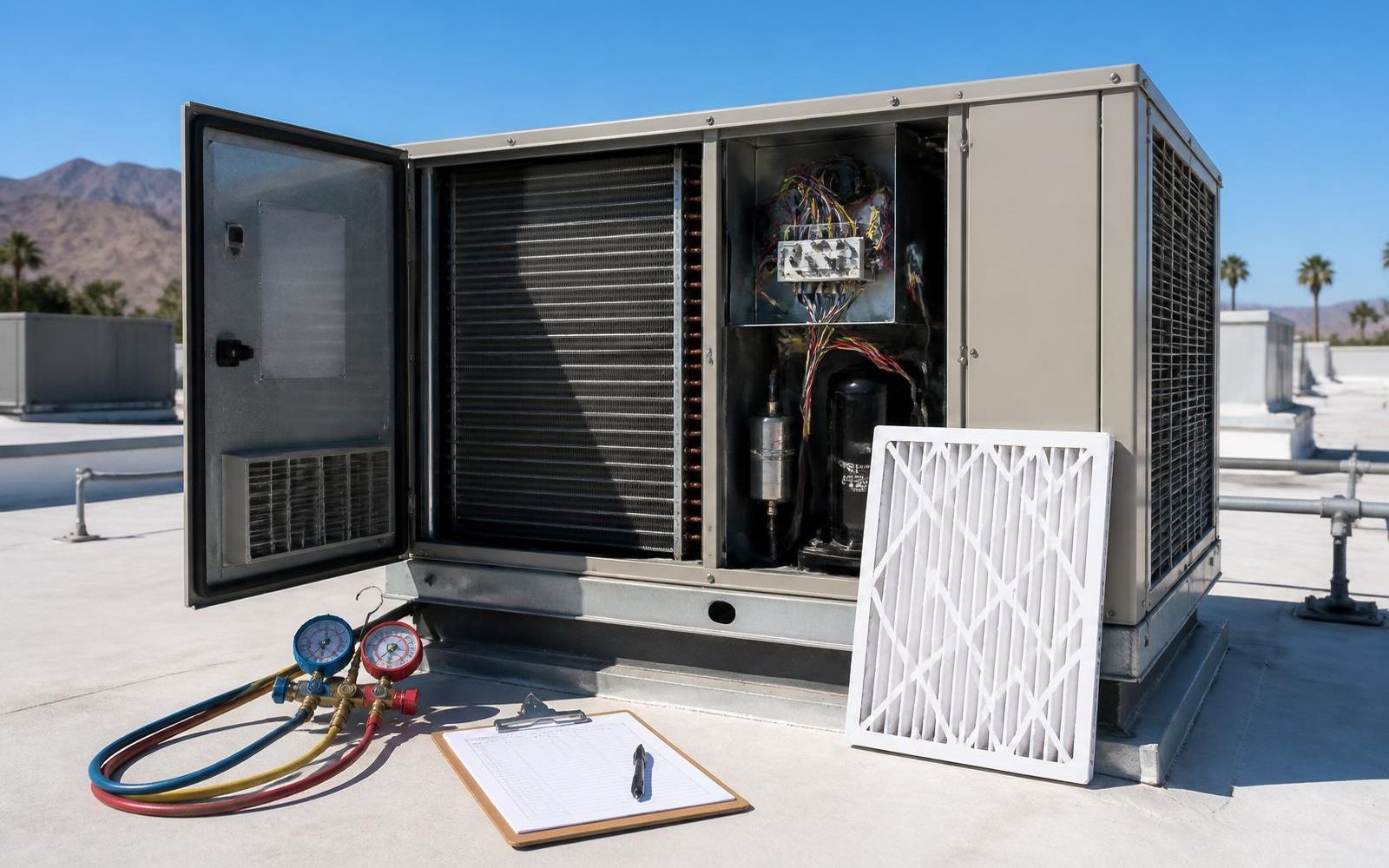
Check contactor points for pitting, capacitors for bulging and out-of-tolerance microfarad readings, wire terminations for heat discoloration, and tighten lugs to spec. Capacitors are one of the highest-frequency failure items in Arizona because heat degrades them, and testing one costs minutes while replacing one after a summer failure costs a service call.
Motor and belt service
On belt-driven commercial units, check belt tension and alignment and inspect sheaves for wear. Lubricate bearings where fittings exist.
Refrigerant performance readings
Take suction and liquid pressures, superheat and subcooling, and compare to the manufacturer's chart. This is the difference between measuring a charge and guessing at one. Note that adding refrigerant without finding the leak is a repair that will come back.
Temperature split and amp draw
Record supply and return temperatures and compressor and fan amperage against nameplate. Trends in these numbers predict failures better than any single reading.
Annual HVAC maintenance checklist
Annual work is the deeper inspection, best scheduled in the shoulder months so findings can be corrected before load arrives.
Full heating side inspection
On gas equipment, inspect the heat exchanger, burners, igniter, flame sensor, and gas train, verify manifold pressure, and check the flue and combustion air path. Phoenix runs heat for a short season, which is exactly why heating components get overlooked until the first cold week.
Economizer inspection
Economizers on rooftop units are frequently found stuck, disconnected, or with a failed actuator or sensor. A failed economizer either wastes free cooling in the winter or pulls in 110 degree outside air in July. Both are expensive.
Ductwork and cabinet integrity
Check accessible duct connections, insulation condition, and cabinet panel gaskets. Leakage into an unconditioned attic or plenum is invisible on the bill until you look for it.
Safety and control verification
Test high and low pressure switches, limit controls, float switches, and any freeze protection. Confirm the building automation or thermostat control sequence matches the intended operation.
Chillers and larger plants
Water-cooled and air-cooled chillers add their own annual scope: tube condition, water chemistry, pump and tower service, vibration and oil analysis where applicable, and starter or VFD inspection.
Equipment condition assessment
Age, refrigerant type, repair history, and remaining life, written down. This is the record that turns a replacement conversation from a surprise into a budget line.
What the documentation should look like
The checklist matters less than the paperwork that comes back from it. A maintenance visit with no readings is a visit you cannot audit and cannot compare against the next one.
A useful service report includes the unit identifier and nameplate data, filter sizes and quantities changed, measured pressures and temperatures, superheat and subcooling, amp draws against nameplate, capacitor readings, a list of deficiencies with urgency levels, and photos of anything the technician is recommending you spend money on.
That record does three things. It lets you see degradation over time instead of reacting to failures. It supports warranty claims, which manufacturers can deny when maintenance is undocumented. And it gives whoever approves the budget a defensible reason for the spend.
A maintenance visit with no documented readings cannot be audited, cannot be trended, and will not support a warranty claim.
Who should be doing which tasks
The dividing line is straightforward. Filter changes, condensate checks, visual inspections, and schedule verification are appropriate for trained in-house staff. Anything involving refrigerant, line voltage, combustion, or control sequences belongs to a licensed technician. Refrigerant handling in particular is federally regulated and requires EPA 608 certification.
For multi-unit portfolios, the more important question is coverage rather than division of labor. A plan should specify visit frequency by equipment type, filter class and who supplies filters, response time commitments, after-hours coverage, and what is included versus billed separately. Our team builds those maintenance plans against an actual equipment list rather than a flat per-unit rate, because a fifteen-year-old twenty-ton rooftop and a three-year-old five-ton split do not need the same attention.
Getting on a schedule
If you are starting from nothing, the sequence is: inventory the equipment, get a baseline inspection with documented readings on every unit, correct the deficiencies that inspection turns up, then set intervals from the checklist above.
Central Mechanical Services LLC was founded in 2019 and works across Phoenix, Scottsdale, Mesa, Tempe, Chandler, Gilbert, Glendale, Peoria, Surprise, Avondale, and Buckeye, serving commercial, industrial, medical, and residential clients under one license. If you want a maintenance scope priced against your building's actual equipment list, contact our team and we will walk the units with you.
Need a Phoenix tech today?
Talk to a real Valley dispatcher - same-day appointments and live answer 24/7.