By the Central Mechanical Services LLC team
Licensed Phoenix mechanical contractor - AZ ROC #325571 & #325622
In this article (10 sections)
- 01The short version
- 0201 | How to isolate a water pressure problem
- 0302 | Fixing single-fixture low pressure
- 0403 | Diagnosing a whole-house pressure drop
- 0504 | Water softener restrictions
- 0605 | Hot water pressure problems
- 0706 | Older homes and galvanized piping
- 0807 | What a professional plumbing diagnostic includes
- 0908 | Frequently asked questions
- 10Fix your water pressure today
A drop in water pressure turns a routine shower into a frustrating chore. If you are dealing with low water pressure in your house in Chandler, the fix could be as simple as unscrewing an aerator or as complex as a whole-house repipe. The first step is figuring out if the issue affects one fixture, one temperature, or the entire property.
Chandler relies on heavily mineralized groundwater and surface water. That hard water destroys plumbing components over time. This guide covers how to isolate a water pressure problem, how to identify water pressure regulator problems, what causes fixture-specific blockages, and when to call a professional. Central Mechanical Services LLC is a Phoenix mechanical contractor licensed under AZ ROC #325571 (CR-39 HVAC and Refrigeration) and AZ ROC #325622 (CR-37 Plumbing), holds a KB-1 Dual Building Contractor license, and is bonded and insured for residential and commercial plumbing across the Valley.
The short version
- Test multiple faucets to determine if the pressure drop is localized to one room or affects the entire property.
- Chandler has extremely hard water. Scale buildup in aerators and showerheads is the most common cause of a single-fixture pressure drop.
- If both hot and cold pressure is terrible everywhere, you likely have a failing pressure reducing valve (PRV) or a partially closed main shutoff.
- If only hot water lacks pressure, the restriction sits at the water heater or the hot water supply lines.
- A degraded water softener resin bed will choke the water supply to the entire house. Testing the bypass valve confirms this issue instantly.
- Do not ignore a sudden, severe pressure drop. It often indicates a hidden leak or a broken main line.
01 | How to isolate a water pressure problem
Before you start replacing parts, define the scope of the problem. Go to the kitchen sink and turn on the cold water. Note the pressure. Turn it off, then turn on the hot water. Note the pressure. Repeat this process in the bathrooms, showers, and exterior hose bibs.
If the kitchen sink is weak but the bathroom shower is strong, the problem is at the kitchen sink. You do not have a main line issue.
If the cold water is fine but the hot water barely trickles out of every faucet, the problem is your water heater or the hot water distribution piping.
If every single fixture in the home lacks pressure, you have low water pressure whole house. This points directly to the main water supply, the main shutoff valve, the water softener, or the pressure reducing valve.
02 | Fixing single-fixture low pressure
Single-fixture issues almost always trace back to hard water scale or trapped debris. Chandler water leaves heavy calcium and magnesium deposits on everything it touches.
Aerators: The screen at the tip of your faucet is the aerator. It traps sediment and scale. Unscrew it by hand or use a towel and pliers to protect the finish. Rinse the screen. If it is crusted white with calcium, soak it in white vinegar for an hour. Reinstall it and check the flow.
Showerheads: Showerhead nozzles clog rapidly with scale. Remove the showerhead and soak it in a bowl of vinegar. If the flow restrictor inside the showerhead is packed with sediment, you might need to extract the debris with a pin or replace the entire fixture.
Angle stops and supply lines: If cleaning the aerator fails, look under the sink. The small valves on the wall are called angle stops. Ensure they are turned completely to the left (open). Shut off the water, disconnect the flexible supply line from the faucet, and point the line into a bucket. Turn the valve back on. If pressure into the bucket is strong, the blockage is inside the faucet cartridge itself.
Faucet cartridges: Cartridges live inside the faucet handle. They wear out over time and trap mineral chunks. Replacing the cartridge usually restores full flow to a stubborn sink or shower.
03 | Diagnosing a whole-house pressure drop
When every faucet suffers from low flow, the restriction sits at the entry point of your plumbing system.
Main shutoff valve: Locate your house main water valve. You will usually find this in a box near the street or attached to the side of the house near the hose bib. Ensure the handle or knob is turned completely to the open position. A partially closed valve chokes the flow for the entire property.
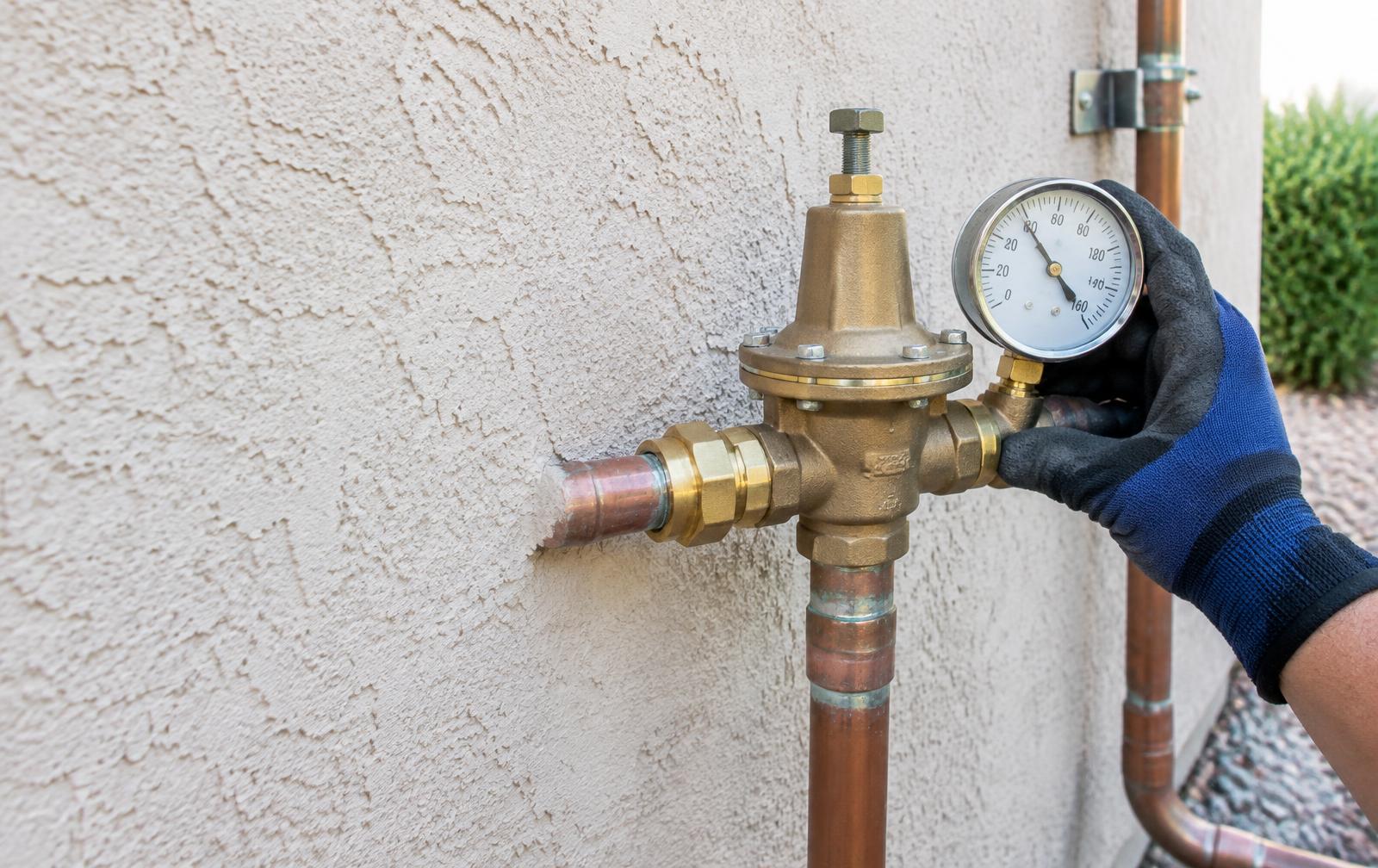
Water pressure regulator problems: Most Chandler homes have a pressure reducing valve (PRV) installed on the main line. The city supplies water at high pressure (often 80 to 120 PSI) to ensure adequate flow through municipal pipes and fire hydrants. The PRV steps that down to a safe 50 to 60 PSI for your home. You will recognize it as a bell-shaped brass valve on the main line. When a PRV fails, it can fail open (causing dangerously high pressure) or fail closed. Failing closed results in a massive drop in pressure everywhere.
Hidden leaks: A major leak in the main service line or under your foundation (a slab leak) diverts water before it reaches your fixtures. Look for unusually green patches of grass, damp soil, or a water meter that spins constantly when all faucets inside the house are turned off.
04 | Water softener restrictions
Nearly every home in Chandler utilizes a water softener to combat the municipal water hardness. Water softeners use a bed of resin beads to remove minerals. Over the course of 10 to 15 years, chlorine in the city water breaks those beads down into a mushy sludge.
When the resin bed collapses, it blocks water from passing through the system. This results in terrible water pressure throughout the entire house.
Testing this is simple. Locate your water softener and find the bypass valve on the back of the unit. Turn the valve to the "bypass" position. This routes water around the softener directly into the house. Go inside and turn on a faucet. If your water pressure instantly returns to normal, your water softener requires replacement or a complete resin bed swap.
05 | Hot water pressure problems
If your cold water flows perfectly but the hot water is weak at every fixture, the bottleneck is at the water heater.
Sediment buildup: Water heaters accumulate calcium sediment at the bottom of the tank. Over time, this sludge can shift and block the hot water outlet pipe. Routine flushing helps prevent this, but a heavily neglected tank may choke completely.
Shutoff valve: Check the cold water inlet valve located just above the water heater. If it was bumped or partially closed during recent garage maintenance, it restricts the amount of water entering the tank. Less water entering the tank means less hot water pushed out to the house.
Corroded dielectric nipples: The fittings connecting the water heater to your copper pipes can corrode internally due to galvanic action. This corrosion creates a rough choke point that severely restricts flow.
06 | Older homes and galvanized piping
If you live in an older Chandler home built before the late 1980s, you might have galvanized steel pipes. Galvanized pipes rust from the inside out. The rust creates a highly textured surface that catches hard water minerals effortlessly.
Over decades, a one-inch galvanized pipe can choke down to the internal diameter of a pencil. This creates severe friction loss. The pressure might look okay for the first two seconds you open a faucet, but it will immediately drop to a trickle as the restricted pipe struggles to deliver volume.
There is no chemical or mechanical way to clean out old galvanized pipes. The only permanent solution is a whole-house repipe using PEX or copper. A repipe typically costs between $5,000 and $12,000 depending on the size of the home, the number of bathrooms, and the amount of drywall access required. PEX is often the preferred replacement material in Arizona because it expands slightly to resist freezing and does not accumulate scale as rapidly as copper.
07 | What a professional plumbing diagnostic includes
Homeowners can handle aerator cleaning, showerhead swaps, and water softener bypass tests. You need a licensed plumber when dealing with main lines, PRVs, or hidden leaks.
Replacing a PRV requires cutting into the main water line, soldering copper, or pressing heavy-duty fittings. Doing this incorrectly will flood your yard or leave your house without water until an emergency crew arrives. A standard PRV replacement usually runs between $350 and $650, depending on access and pipe size.
When you hire a plumber Chandler AZ trusts, the diagnostic process is systematic. A professional will attach a pressure gauge to a hose bib to test the static pressure. They will then open fixtures to test the dynamic pressure (the pressure while water is moving). This tells the plumber immediately if the issue is a failed PRV or a volume restriction inside the walls. If necessary, they will use thermal imaging or acoustic listening devices to rule out a slab leak.
08 | Frequently asked questions
What is normal water pressure for a house? Normal residential water pressure falls between 50 and 70 PSI. Anything below 40 PSI will feel weak in the shower. Anything above 80 PSI damages appliance valves, blows out flexible supply lines, and voids water heater warranties.
Does the city of Chandler guarantee a specific water pressure? The city provides water to the meter at a pressure sufficient for municipal needs and fire protection. They do not regulate the pressure inside your home. Managing that pressure is the job of your private pressure reducing valve.
Can a municipal water main break affect my house? Yes. If the city is repairing a water main in your neighborhood, you will experience a temporary drop in pressure. This is usually accompanied by brown or cloudy water when the flow is restored. Run your exterior hose bibs until the water clears.
Will a new showerhead fix low pressure? It will only fix the pressure if the old showerhead is packed with scale. If the pressure to the entire bathroom is low, putting a new showerhead on a restricted pipe will not change the outcome.
Fix your water pressure today
You do not have to live with a trickle in the shower or a kitchen faucet that takes ten minutes to fill a pot. If you have cleaned your aerators and checked your softener bypass but the pressure remains terrible, you need an accurate diagnosis of your main line and valves. Call Central Mechanical Services for residential plumbing diagnostics, PRV replacements, leak detection, and whole-house repiping across Chandler and the Phoenix metro area. Our dispatch operates 24/7 for plumbing emergencies. Reach out today to get your water pressure back to normal.
Need a Phoenix tech today?
Talk to a real Valley dispatcher - same-day appointments and live answer 24/7.