By the Central Mechanical Services LLC team
Licensed Phoenix mechanical contractor - AZ ROC #325571 & #325622
In this article (8 sections)
- 01Signs your Phoenix water heater needs repair, not replacement
- 02When to replace instead: age, corrosion, and the Phoenix hard-water factor
- 03What water heater repair should cost in Phoenix in 2026
- 04Tank vs tankless water heater in Phoenix: which makes sense in Arizona
- 05Why Phoenix water heaters fail faster (hard water, garage installs, sediment)
- 06What our techs do on a water heater service call
- 07When it's an emergency (and when it can wait until morning)
- 08Ready to fix or replace your Phoenix water heater?
Water heaters fail faster in Phoenix than almost anywhere in the country. Between some of the hardest municipal water in the United States, garage installs that bake at 130 degrees every summer, and homes that were built and plumbed in a Valley boom, most Phoenix water heaters are running on borrowed time by year eight.
This guide covers the honest homeowner questions: when water heater repair in Phoenix is the right call, when replacement is the smarter money, what it should cost in 2026, and whether a tankless swap actually pays off in Arizona. Everything below is what our Central Mechanical Services plumbers tell friends and neighbors before we ever quote a job.
Signs your Phoenix water heater needs repair, not replacement
Not every problem means a new unit. Five symptoms usually point to a repair on a tank that still has good years left:
1. Water is warm but never hot. Nine times out of ten this is a failed lower heating element (electric) or a bad thermocouple or gas control valve (gas). Sub-$400 fix on most Phoenix homes. 2. Pilot won't stay lit. Almost always the thermocouple, occasionally the flame sensor. Under $250 with a licensed plumber. 3. Popping or rumbling from the tank. That's sediment shifting on the burner plate. A professional flush and anode inspection usually restores quiet operation and recovers 10 to 20 percent of heating efficiency. 4. Slow recovery after showers. Element or dip tube. Both are cheap parts if the tank is under 8 years old. 5. A single small drip at a fitting on top of the tank. That's a union or nipple, not the tank shell. Replace the fitting, not the water heater.
The rule of thumb: if the leak is anywhere on top of the tank, it's plumbing. If it's on the side or bottom of the tank, it's the tank shell rusting through, and no repair will save it.
When to replace instead: age, corrosion, and the Phoenix hard-water factor
Standard tank water heaters in Phoenix rarely last their nameplate 10 to 12 years. Our field average is closer to 8 to 10 years for gas tanks and 10 to 12 for electric, and every year past that is borrowed time.
Replace the unit, don't repair it, if any of these are true: the tank is 10 years or older; you see rust in the hot water at the tap; there's any moisture on the side or bottom of the tank; the anode rod hasn't been inspected in 5+ years and the tank is past year 8; or the repair cost is more than 40 percent of a new install.
Phoenix hard water is the accelerator on all of it. Valley tap water routinely tests at 15 to 20 grains per gallon of hardness, and every gallon of that mineral load builds up on the burner plate and eats through a sacrificial anode rod years faster than the manufacturer expected. A tank protected by a softener and an anode swap at year 5 will outlive one that isn't by half a decade.
What water heater repair should cost in Phoenix in 2026
Honest 2026 pricing across the Valley for a licensed plumber (labor, parts, and permit where required):
• Diagnostic service call: $89 to $129, usually credited to the repair. • Thermocouple or flame sensor replacement: $180 to $320. • Gas control valve replacement: $350 to $600. • Heating element (electric): $220 to $400 per element. • Full tank flush and anode inspection: $180 to $280. • Anode rod replacement: $220 to $380. • Expansion tank replacement (code required on most Phoenix installs): $220 to $350. • Standard 40 or 50 gallon gas tank replacement, installed to code with new expansion tank, drip pan, and haul-away: $1,900 to $2,900. • Tankless gas water heater installation (Rinnai, Navien, Rheem class): $4,200 to $6,800 depending on venting and gas line upsize.
If anyone quotes a $99 water heater install, walk away. It's a bait price. And if a repair estimate crosses roughly 40 percent of a full replacement on a tank 8+ years old, replace it. You'll spend the delta again inside two years chasing the next failure. Our licensed Phoenix plumbing team can walk both numbers in the same visit.
Tank vs tankless water heater in Phoenix: which makes sense in Arizona
Tankless is genuinely a better fit in Phoenix than in most climates, and here's why: inlet water temperature. In colder markets a tankless has to raise 45 degree groundwater to 120 degrees, which pushes it near capacity. Phoenix inlet water sits around 75 degrees in summer and 60 to 65 degrees in winter, so a properly sized tankless barely breaks a sweat.
Choose a tankless if: you have a 3-bath house with real simultaneous demand, you're tired of a garage tank in 130 degree ambient temps, you want 20+ years of service life, and you'll actually flush it annually to fight hard-water scale.
Stick with a tank if: your home has a single main bath, you don't want to upsize gas line or venting, or your budget wants the lower up-front number. A quality gas tank installed to code is still an 8 to 12 year workhorse in the Valley.
The one Phoenix-specific caveat both directions: hard water. A tankless without annual descaling will fail in 6 years instead of 20. A tank without a fresh anode rod at year 5 will fail at year 7 instead of 12. Whichever you choose, budget for the maintenance.
Why Phoenix water heaters fail faster (hard water, garage installs, sediment)
Three Phoenix conditions gang up on every tank in the Valley.
First, hard water. Central Arizona Project water is loaded with calcium and magnesium, and every gallon that flows into your tank leaves a little behind. Over 5 years that becomes an inch of rock-hard scale on the burner plate that traps heat against the tank floor and cooks the steel from the inside.
Second, garage installs. Most Valley homes have the water heater in the garage or a utility closet off the garage. Summer ambient in that space routinely hits 120 to 135 degrees. The tank is trying to hold hot water while sitting inside an oven, which stresses the gas control valve and expansion tank far beyond national norms.
Third, high water pressure. Phoenix municipal pressure often runs 75 to 90 psi at the meter. Anything over 80 will destroy an expansion tank in 2 to 3 years and shorten the life of every fitting on the water heater. A $180 pressure-reducing valve is the single best plumbing investment most Valley homes never make.
What our techs do on a water heater service call
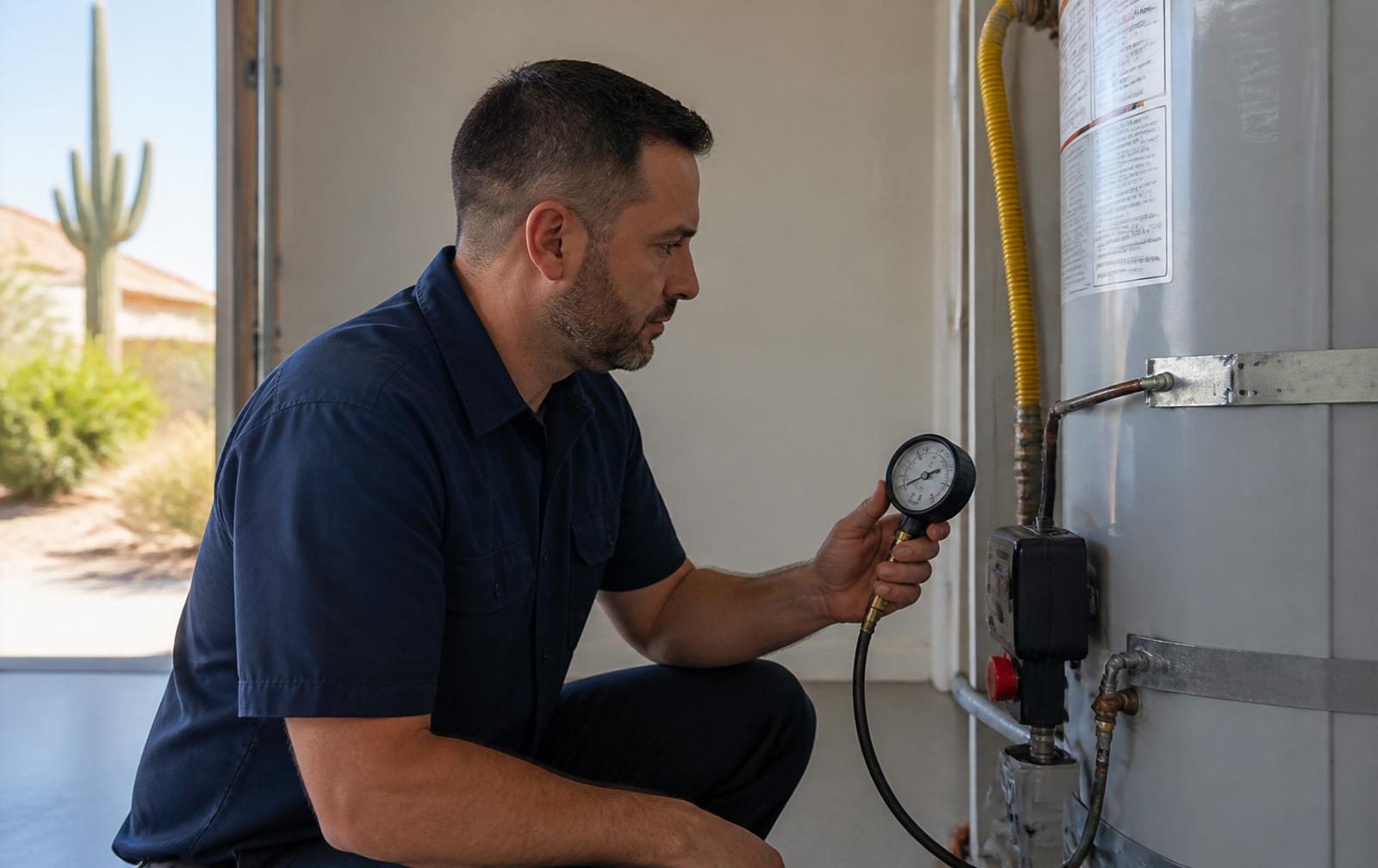
A real water heater diagnostic visit isn't a five-minute glance. Our Central Mechanical Services plumbers run a 12-point check on every call:
1. Measure incoming water pressure at the closest hose bib. 2. Test water temperature at the tap and confirm it against thermostat setpoint. 3. Inspect the T&P (temperature and pressure) relief valve and its drain line to code. 4. Inspect the expansion tank and test bladder pressure against the incoming water pressure. 5. Inspect the anode rod (or estimate remaining life from age and hardness). 6. Check the gas control valve, thermocouple, and burner (gas) or elements and thermostats (electric). 7. Flush the tank and measure sediment volume. 8. Inspect flue draft and combustion air on gas units. 9. Inspect the drip pan and drain line for corrosion or blockage. 10. Test the shutoff valve on the cold inlet. 11. Photograph the data plate and record age, capacity, and BTU or wattage. 12. Deliver a written report with repair options, replacement options, and estimated remaining life.
If your last visit didn't include a T&P test, a flush, and an anode assessment, you paid for a look, not a service.
When it's an emergency (and when it can wait until morning)
Call the emergency line immediately if: the tank is actively leaking water onto the floor from the shell, you smell gas near a gas water heater, the T&P valve is discharging steam or hot water continuously, or the flue vent is disconnected on an atmospheric gas unit.
It can safely wait until morning if: you have no hot water but the tank is dry underneath, a pilot light is out with no gas smell, or you have a slow drip from a fitting on top of the tank that you can catch with a bucket. Shut off the cold water inlet valve on top of the tank, kill the gas or breaker, and call at 7am.
For anything in the first category, our 24/7 emergency dispatch covers the full Valley from Buckeye to Queen Creek.
Ready to fix or replace your Phoenix water heater?
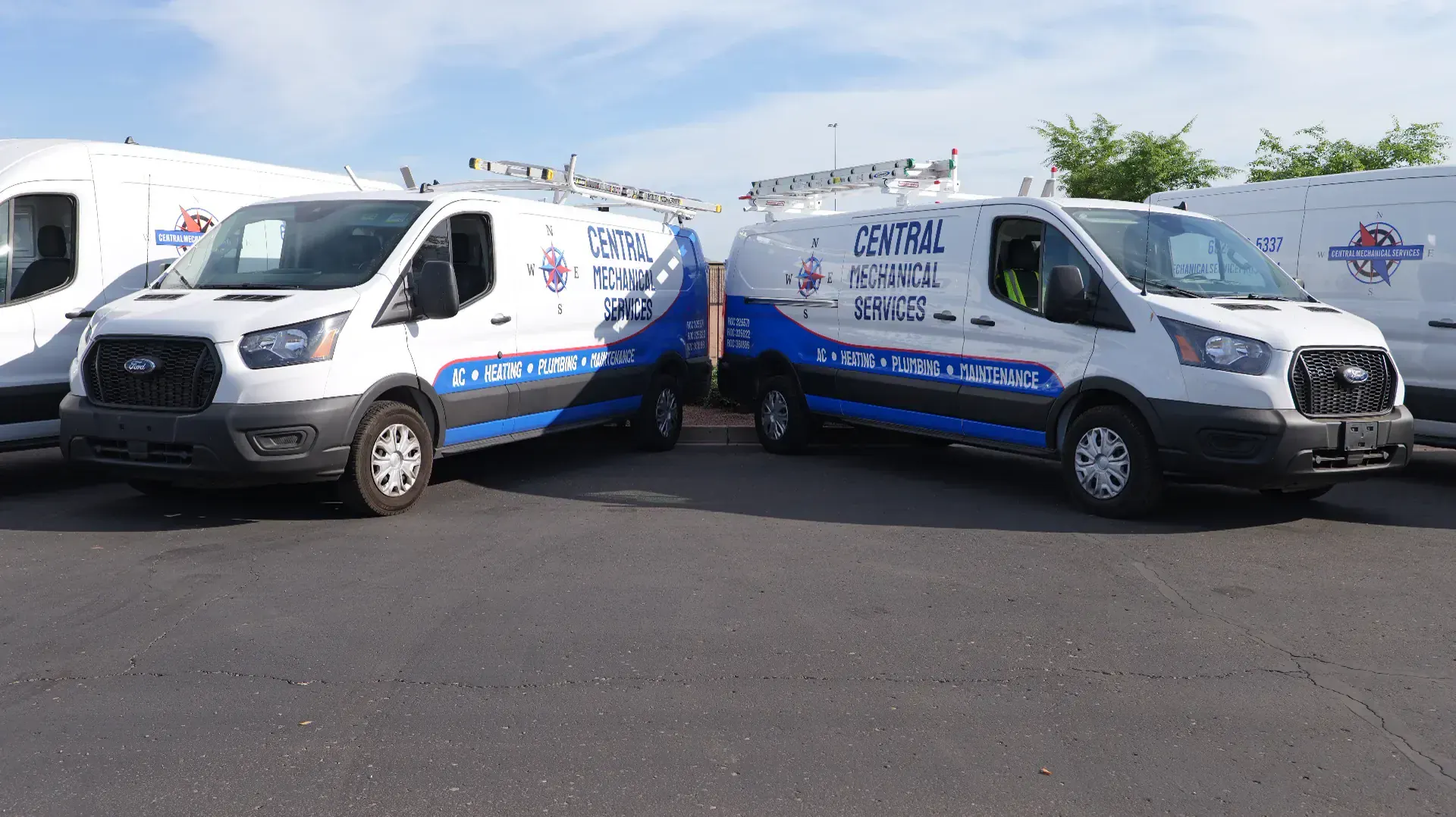
Central Mechanical Services has been diagnosing water heaters across Phoenix, Scottsdale, Mesa, Tempe, Chandler, Gilbert, Glendale, and the rest of the Valley since 2019, backed by 150+ years of combined field experience. Every quote comes with both the repair and replacement number so you can make the call on real math, not pressure.
Explore next: browse full plumbing services, review this month's specials, see how the Central Care Club maintenance plan bundles annual water-heater flushes with HVAC tune-ups, or read our Phoenix AC Tune-Up Guide to keep every mechanical system in your home on the same maintenance calendar.
Need a Phoenix tech today?
Talk to a real Valley dispatcher - same-day appointments and live answer 24/7.