By the Central Mechanical Services LLC team
Licensed Phoenix mechanical contractor - AZ ROC #325571 & #325622
In this article (9 sections)
- 01Why water heaters fail differently in Phoenix
- 02Warning signs, and what each one usually means
- 03What a proper water heater diagnostic should include
- 04Water heater repair vs replacement Phoenix: How to decide
- 05Tank versus tankless systems in the Valley
- 06Maintenance that actually extends equipment life
- 07What drives water heater installation Phoenix costs
- 08Frequently asked questions
- 09How to choose a plumbing contractor
The short version
- Phoenix hard water destroys water heaters faster than the national average, making calcium scale the leading cause of premature failure.
- Most repair calls trace back to burned out heating elements, failed thermocouples, faulty gas valves, or blown pressure relief valves, rather than a ruptured tank.
- Tank leaks, widespread rust, and ages past eight years usually mean replacement is the only mathematical choice.
- Flushing the tank annually and replacing the anode rod can double the lifespan of a system in the Valley.
- Plumbing work requires permits and specific code compliance, so the contractor quoting it should hold a commercial and residential plumbing license in Arizona.
In this article (9 sections)
- Why water heaters fail differently in Phoenix
- Warning signs, and what each one usually means
- What a proper water heater diagnostic should include
- Water heater repair vs replacement Phoenix: How to decide
- Tank versus tankless systems in the Valley
- Maintenance that actually extends equipment life
- What drives water heater installation Phoenix costs
- Frequently asked questions
- How to choose a plumbing contractor
Every residential and commercial building relies on a functional water heater to maintain operations and hygiene. When a tank stops producing hot water or starts leaking, the disruption is immediate. A broken system forces a fast choice between a patch and a full replacement. This guide covers why water heaters fail the way they do here, what the warning signs mean, how to decide on water heater repair Phoenix, what drives installation costs, and the maintenance that actually prevents premature tank death. Central Mechanical Services LLC is a Phoenix mechanical contractor licensed under AZ ROC #325571 (CR-39 HVAC and Refrigeration) and AZ ROC #325622 (CR-37 Plumbing), holds a KB-1 Dual Building Contractor license, and is bonded and insured, handling plumbing and mechanical systems across the Valley.
Why water heaters fail differently in Phoenix
Water heaters in the Phoenix metro area live harsh, short lives. The national average lifespan for a standard tank is ten to fifteen years. In the Valley, six to ten years is the reality. The culprit is the water supply. Phoenix draws water with extremely high levels of dissolved calcium and magnesium. When hard water heats up, those minerals fall out of suspension and bake onto the bottom of the tank and the heating elements.
This calcium scale creates an insulating barrier between the heat source and the water. Gas burners have to fire longer and hotter to push heat through the rock layer. Electric elements become encased in scale, overheat, and short out. The constant overheating stresses the steel tank, degrades the interior glass lining, and accelerates corrosion. This mineral buildup is the root cause of almost every component failure and tank rupture in the region.
Warning signs, and what each one usually means
Equipment gives signals before it fails completely. Recognizing these indicators prevents a minor issue from becoming a flooded mechanical room or garage.
No hot water means the heat source has stopped firing. On an electric unit, this points to a tripped breaker, a failed thermostat, or a burned out upper heating element. On a gas unit, it indicates a bad thermocouple, a faulty gas control valve, or an extinguished pilot light.
A popping or rumbling noise during operation means boiling water is trapped under a thick layer of calcium sediment at the bottom of the tank. The noise is steam bubbles bursting through the rock layer. This indicates severe scale buildup and impending tank damage.
Puddles around the base of the unit mean a leak. If the water comes from the temperature and pressure relief valve, the system is over-pressurized or overheating. If the water seeps directly from the steel tank jacket, the internal vessel has rusted through and the unit is dead.
Rusty or discolored hot water points to internal tank corrosion. The sacrificial anode rod has likely been consumed, and the water is now eating the steel tank itself.
What a proper water heater diagnostic should include
A professional diagnostic goes beyond confirming that the water is cold. A technician must isolate the failed component and assess the overall health of the tank to provide a responsible recommendation.
For electric tanks, the technician will use a multimeter to check incoming voltage, test the upper and lower thermostats for continuity, and measure the resistance of the heating elements. They will also inspect the wiring block for melted insulation caused by loose connections.
For gas tanks, the diagnostic focuses on the burner assembly. The technician will test the thermocouple to ensure it generates the required millivolts to hold the gas valve open. They will check gas pressure, inspect the burner orifice for blockages, and verify that the flue drafts correctly to prevent carbon monoxide spillage.
On all tanks, the technician must check the temperature and pressure relief valve for proper operation and inspect all copper or PEX supply connections for slow drips and galvanic corrosion. They will also look at the date code on the data plate to establish the exact age of the equipment.
Water heater repair vs replacement Phoenix: How to decide
Choosing between a targeted repair and buying a new unit comes down to age, the location of the leak, and the cost of the fix.
Repair makes sense when the unit is less than six years old, the tank is structurally sound, and the problem is a replaceable part. Thermocouples, gas valves, heating elements, thermostats, and pressure relief valves are all standard repairs. If a four-year-old tank stops heating because of a burned element, you replace the element.
Water heater replacement Phoenix becomes necessary when the tank itself is leaking. A rusted internal tank cannot be patched or welded. Replacement is also the right mathematical choice when a major repair, like a gas control valve, is required on a tank older than eight years. Sinking hundreds of dollars into a unit nearing the end of its life expectancy is a poor allocation of capital. The tank will likely fail shortly after the repair.
If the unit is heavily scaled, makes loud rumbling noises, and cannot be drained because the drain valve is clogged with sediment, replacement is the only practical option regardless of age.
Tank versus tankless systems in the Valley
When replacing a system, property owners often consider moving from a traditional tank to a tankless water heater. Tankless units heat water on demand, eliminating the standby energy loss of keeping fifty gallons of water hot 24 hours a day. They take up less space and provide an endless supply of hot water.
However, tankless systems have specific requirements that make retrofitting complex. A gas tankless unit requires a much larger gas line than a standard tank, often meaning new gas pipe run from the meter. They also require dedicated 120-volt electrical outlets and specialized concentric venting.
More importantly, tankless heat exchangers are highly sensitive to Phoenix hard water. The narrow pathways inside a tankless unit will clog with calcium rapidly if the water is not treated. Installing a tankless system here requires a commitment to annual chemical descaling or the installation of a whole building water softener to protect the investment.
Maintenance that actually extends equipment life
Water heaters are not maintenance-free appliances. Spending time on basic upkeep directly extends the lifespan of the equipment and maintains its efficiency.
Flushing the tank is the most critical task. Connecting a hose to the drain valve and flushing the loose sediment out once a year prevents the thick calcium layer from forming. This keeps the heating elements clear and prevents the bottom of a gas tank from overheating.
Checking and replacing the anode rod is the second requirement. The anode rod is a magnesium or aluminum core that attracts corrosive elements in the water. It sacrifices itself so the steel tank does not rust. In Phoenix, hard water consumes anode rods quickly. Having a technician check the rod every two years and replacing it when it degrades to a wire core will add years to the life of the tank.
Exercising the temperature and pressure relief valve annually ensures it will open in an emergency, preventing a catastrophic tank rupture.
What drives water heater installation Phoenix costs
The price of a new system is never just the cost of the tank on the shelf at a supply house. Water heater installation Phoenix involves labor, parts to bring the system up to current plumbing codes, and safe disposal of the old unit.
Equipment size and type dictate the base price. A standard 40-gallon electric tank costs less than a 50-gallon power vent gas model or a high-efficiency commercial boiler.
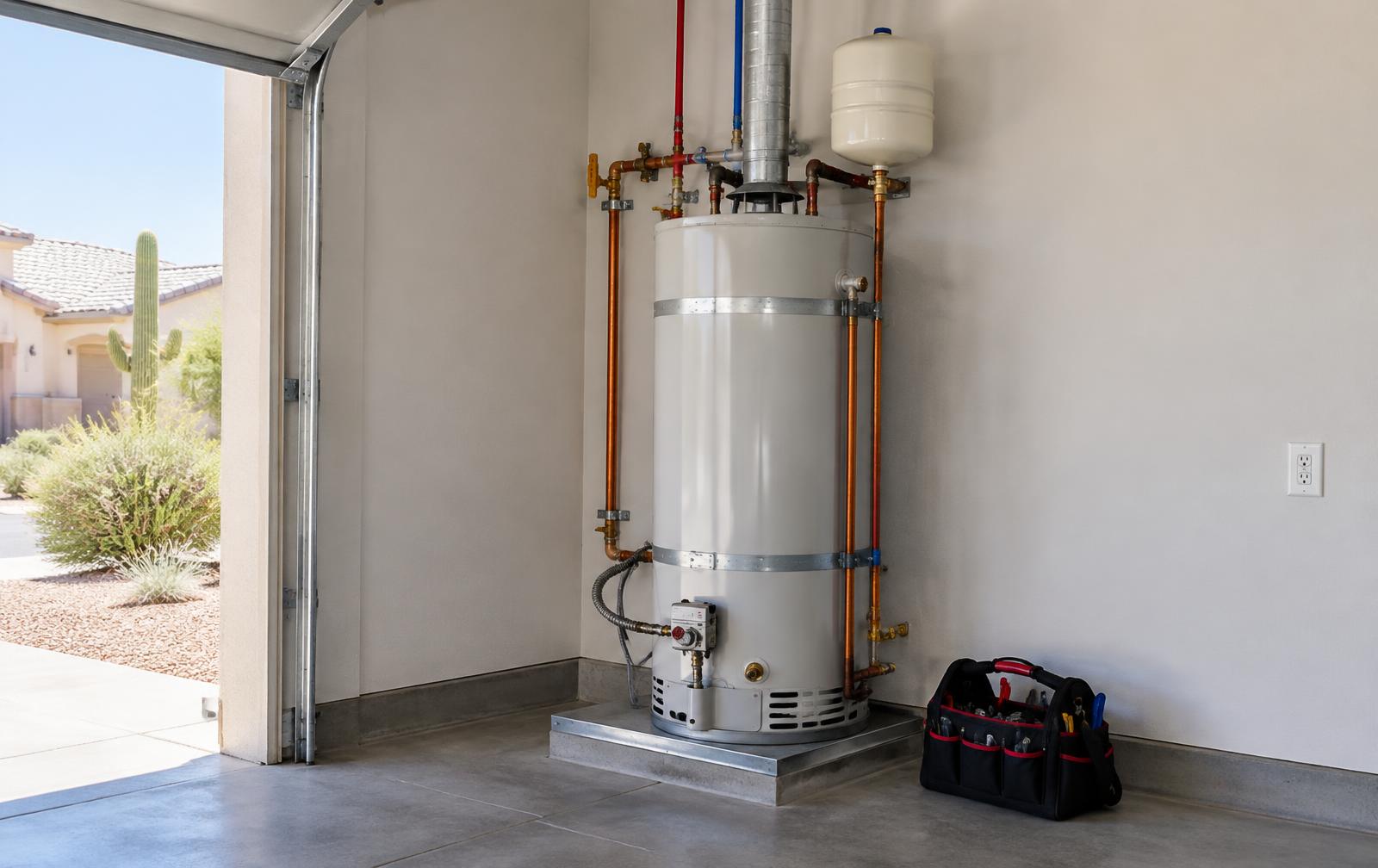
Code upgrades are common on older properties. Current municipal codes often require the addition of a thermal expansion tank, a dedicated drip pan, new braided stainless steel supply lines, and an earthquake strap system. If the existing gas valve is outdated or leaking, that must be replaced as well.
Location and access heavily influence labor costs. Swapping a unit in an open two-car garage is straightforward. Draining and removing a failed 80-gallon tank from a cramped third-floor attic or a tight commercial mechanical closet requires specialized rigging, more time, and carries higher risk, which increases the total cost.
Frequently asked questions
How long does a water heater last in Phoenix? Standard tank water heaters typically last between six and ten years in the Phoenix area. Hard water scale and high mineral content accelerate wear on components and internal tank linings, cutting the lifespan shorter than the national average.
Is a leaking water heater an emergency? Yes. A leak from the base of the tank means the internal structure has failed. The tank will not heal itself, and a slow drip can turn into a major rupture at any moment, causing severe water damage to drywall, flooring, and property.
Can I just replace my anode rod instead of buying a new tank? If the tank is not leaking and is relatively young (under six years), replacing a depleted anode rod is a smart preventative measure. If the tank is already rusting or older than ten years, a new rod will not reverse the damage.
Why is my hot water pressure suddenly low? Low hot water pressure usually points to a calcium blockage in the supply lines, a failing shutoff valve, or sediment clogging the internal dip tube. It requires a diagnostic to locate the restriction.
How to choose a plumbing contractor
Water heater replacement involves high voltage electricity, natural gas lines, carbon monoxide venting, and pressurized water. It is not a casual handyman project. Improper installation leads to gas leaks, electrical fires, or severe flooding.
You need a contractor who understands local code requirements, pulls the correct permits, and stands behind their labor. Look for a company that holds an active plumbing license with the Arizona Registrar of Contractors. Ask if their technicians are employees or subcontractors, and verify they carry proper commercial liability insurance.
Central Mechanical Services LLC provides commercial and residential plumbing services across Phoenix, Scottsdale, Mesa, Tempe, Chandler, Gilbert, Glendale, Peoria, Surprise, Avondale, and Buckeye. If you have no hot water, a leaking tank, or need an honest assessment of your current system, call our dispatch center to schedule a licensed technician. We offer 24/7 emergency response for critical failures.
Need a Phoenix tech today?
Talk to a real Valley dispatcher - same-day appointments and live answer 24/7.