
By the Central Mechanical Services LLC team
Licensed Phoenix mechanical contractor - AZ ROC #325571 & #325622
The short version
- A slab leak is a failed water line in or under the concrete foundation, and supply leaks behave very differently from drain leaks.
- No single symptom proves a slab leak. A rising bill, a moving meter, a warm floor spot, or a musty smell are reasons to test, not a diagnosis.
- Proper detection is pressure isolation first, then acoustic, thermal, and line tracing to mark an exact spot before any concrete is cut.
- Repair options range from a spot repair to a reroute or a full repipe, and the right one depends on location, pipe material, and failure history.
In this article (11 sections)
- 01What is a slab leak?
- 02Warning signs of a slab leak
- 03Could this be a slab leak? A symptom-by-symptom read
- 04Why under-slab plumbing fails
- 05Phoenix and Arizona considerations
- 06How professional slab leak detection works
- 07Slab leak repair options
- 08What affects slab leak repair cost
- 09Does homeowners insurance cover a slab leak?
- 10What to do if you suspect a slab leak
- 11Professional plumbing and leak detection in Phoenix
A slab leak is a leak in a water line that runs beneath the concrete foundation of a house. Because the pipe is buried under several inches of concrete, the leak usually announces itself indirectly: a water bill that climbs for no reason, a meter that keeps turning after every fixture is off, a warm patch on the floor, or a musty smell that will not go away. None of those symptoms proves a slab leak on its own. Each one is a reason to test rather than a diagnosis.
This guide walks through what the symptoms actually mean, how professional leak detection narrows a leak down to a specific spot before anyone touches concrete, which repair approaches exist and when each is worth considering, and the factors that move the price. Central Mechanical Services LLC is a Phoenix mechanical contractor licensed under AZ ROC #325622 (CR-37 Plumbing) and AZ ROC #325571 (CR-39 HVAC and Refrigeration), bonded and insured, with a master plumber on staff leading plumbing service across the Valley.
What is a slab leak?
Most Valley homes are built slab-on-grade: a single poured concrete foundation sitting directly on prepared soil, with no basement and no crawlspace. Plumbing that serves the house either runs through the attic and drops down inside walls, or runs under and through that slab. When a line embedded in or beneath the slab fails, that is a slab leak.
The distinction that matters most is pressurized supply versus gravity drain. A supply-side leak is fed by constant system pressure, so it runs continuously, wastes water every hour, and shows up on the meter. A drain-side leak only releases water when something upstream is draining, which makes it far quieter and harder to catch. The two are found using different methods and repaired in different ways, so identifying which system is involved is the first real step in any diagnosis.
Hot-water lines are worth calling out separately. A leak on the hot side can transfer heat into the slab above it, which is where the classic warm-spot-on-the-floor symptom comes from. A cold-line leak produces no such clue.
Warning signs of a slab leak
Treat everything below as a prompt to investigate. Several of these signs have ordinary explanations that have nothing to do with the foundation, and a competent diagnosis rules those out before concrete is ever discussed.
Water use rises with no change in habits
A steady month-over-month climb in consumption, especially when nothing about the household changed, is one of the more reliable early indicators of a continuous supply-side leak. Irrigation faults and running toilets produce the same pattern, so both need to be eliminated first.
The meter moves with everything shut off
With all fixtures, appliances, ice makers, and irrigation off, the meter should be still. Continued movement means water is going somewhere, though not necessarily under the slab.
The sound of running water in a quiet house
A faint hiss or trickle audible near a wall or floor when nothing is running can indicate pressurized water escaping a line.
A warm or hot area on the floor
Localized warmth on tile or hard flooring can point to a leaking hot-water line beneath. Sun exposure through a window and in-floor heating in a remodeled area can mimic this.
Damp flooring, warped planks, or lifting tile
Moisture migrating up through concrete can loosen flooring adhesive, cup wood, or lift grout and tile in one area.
Musty odor, mildew, or unexplained moisture
Persistent damp smell near baseboards, closets, or the lowest point of a room may indicate moisture in or under the slab. Air conditioning condensate problems can also cause this, which is worth checking on the HVAC side.
Reduced water pressure
A noticeable, sustained drop in pressure throughout the house can occur when a significant volume is escaping before it reaches fixtures. Pressure regulator failure and supply-side issues produce the same complaint.
New cracking in flooring or the slab surface
Fresh cracks are not proof of a leak, and cracks appear in slabs for reasons unrelated to plumbing. Combined with moisture or a moving meter, they justify testing.
No single symptom confirms a slab leak. What confirms it is isolation testing that proves water is leaving a specific pressurized line, followed by locating that loss.
Could this be a slab leak? A symptom-by-symptom read
This is the practical version of the question most people are actually asking. For each symptom: what else it could be, what you can safely check yourself, what needs professional equipment, and how quickly it should be handled.
Water bill spike
- Other explanations
- irrigation leak or controller fault, running toilet flapper, pool auto-fill, seasonal landscape watering.
- You can check
- run a toilet dye test, walk the irrigation zones, compare the bill to the same month last year.
- Needs a professional
- pressure isolation testing to separate the house supply from irrigation and prove where the loss is.
- Urgency
- moderate, schedule testing within days.
Meter turns with fixtures off
- Other explanations
- an appliance filling silently, an unnoticed outdoor hose bib, an irrigation valve failing to close.
- You can check
- confirm every fixture, ice maker, softener, and hose is off, then watch the meter for 20 to 30 minutes.
- Needs a professional
- isolating the meter side from the house side and testing the supply system under pressure.
- Urgency
- moderate to high, water is being lost continuously.
Warm spot on the floor
- Other explanations
- direct sun through glass, a nearby water heater or duct, radiant floor heat installed in a remodel.
- You can check
- whether the warmth persists at night and away from sunlight.
- Needs a professional
- thermal and acoustic survey of the hot-water line path.
- Urgency
- moderate to high if paired with any meter movement.
Sound of running water
- Other explanations
- a toilet refilling, a recirculation pump, water hammer, a nearby appliance.
- You can check
- whether the sound continues after shutting the main supply valve. If it stops with the main closed, water is moving inside the plumbing.
- Needs a professional
- acoustic listening equipment to trace the source through concrete.
- Urgency
- high if the sound is constant.
Damp flooring or lifting tile
- Other explanations
- an appliance or fixture leak above the slab, a failed wax ring, exterior drainage pushing moisture in, an air conditioning condensate line problem.
- You can check
- visible plumbing connections, under sinks, around the water heater and toilets, and whether the condensate drain is flowing.
- Needs a professional
- moisture mapping and supply isolation testing.
- Urgency
- high, active moisture damages flooring and can support mold growth.
Musty smell with no visible water
- Other explanations
- poor ventilation, a past spill under flooring, HVAC humidity issues.
- You can check
- whether the odor is localized to one room or area.
- Needs a professional
- moisture readings and leak isolation.
- Urgency
- moderate.
Low pressure throughout the house
- Other explanations
- a failing pressure regulator, a partially closed main valve, municipal supply work, scale buildup at fixtures.
- You can check
- whether the drop affects every fixture or only one, and whether it appeared suddenly.
- Needs a professional
- static and flowing pressure testing at the service entrance.
- Urgency
- moderate.
Why under-slab plumbing fails
Under-slab supply lines fail for a handful of recurring reasons, and the cause matters because it shapes the repair decision. Corrosion of buried metallic pipe is one, driven by the chemistry of the surrounding soil and moisture in contact with the pipe exterior. Abrasion is another: a line that was not properly sleeved or bedded can wear against concrete or rock as it expands, contracts, and vibrates over decades of use.
Mechanical stress from ground movement is a third. Where soil beneath a foundation swells, shrinks, or settles unevenly, the slab and anything embedded in it can be stressed. The Arizona Geological Survey documents expansive and collapsing soils as a recognized hazard in parts of the state, along with land subsidence and earth fissures in some south-central Arizona basins. Whether a specific property sits on problem soil is a site-specific question, not a blanket assumption.
Installation defects account for more failures than most homeowners expect: a nicked pipe wall during construction, an unsupported joint, a fitting under strain, or a line pulled tight against an angle it was never meant to sit at. These often surface years later, in one spot, with no wider pattern of deterioration.
Finally, age. A house built with a pipe material and installation practice common to its decade will eventually reach the end of that system's service life, and when one under-slab failure appears in an aging system, the question of whether more will follow becomes legitimate.
Phoenix and Arizona considerations
A few local conditions are worth knowing, stated as what they are rather than stretched into claims they do not support.
Construction style
Slab-on-grade is the dominant residential foundation type across the Valley. That is precisely why under-slab plumbing is a live issue here and a non-issue in regions built over basements.
Water mineral content
The City of Phoenix 2025 Water Quality Report lists total hardness in the distribution system at 172 to 302 ppm, or roughly 10 to 17.6 grains per gallon, and states that hard water can cause some types of scaling in pipes and water heaters and on plumbing fixtures such as faucets and showerheads. That is a verified local water characteristic and a documented scaling effect. It is not, on its own, evidence that mineral content causes leaks in buried supply lines, and this guide does not make that claim. Scaling and under-slab pipe failure are separate subjects, and anyone telling you Phoenix water is the reason your slab is leaking is asserting something the water quality report does not establish.
Soil behavior
As noted above, the Arizona Geological Survey identifies expansive and collapsing soils, subsidence, and earth fissures as geologic hazards present in parts of Arizona. Their homeowner-facing material is a reasonable starting point if you want to understand what is documented near you.
Water is expensive to waste here
EPA WaterSense reports that household leaks can waste roughly 9,400 gallons per year for an average family. A continuously running under-slab supply leak is one of the few leaks that can run for months without anyone seeing a drop of water.
How professional slab leak detection works
Good detection is a process of elimination that ends with a marked location, not a guess followed by demolition. The methods below are used in combination, because each one answers a different question.
- 1
Pressure testing and line isolation
The supply system is isolated and pressurized, then monitored. If pressure falls with the system sealed, water is escaping somewhere in that section. By isolating hot from cold and section from section, the leak is narrowed to a specific run before any listening begins. This is the step that separates a real slab leak from an irrigation fault or a fixture problem.
- 2
Acoustic and electronic leak detection
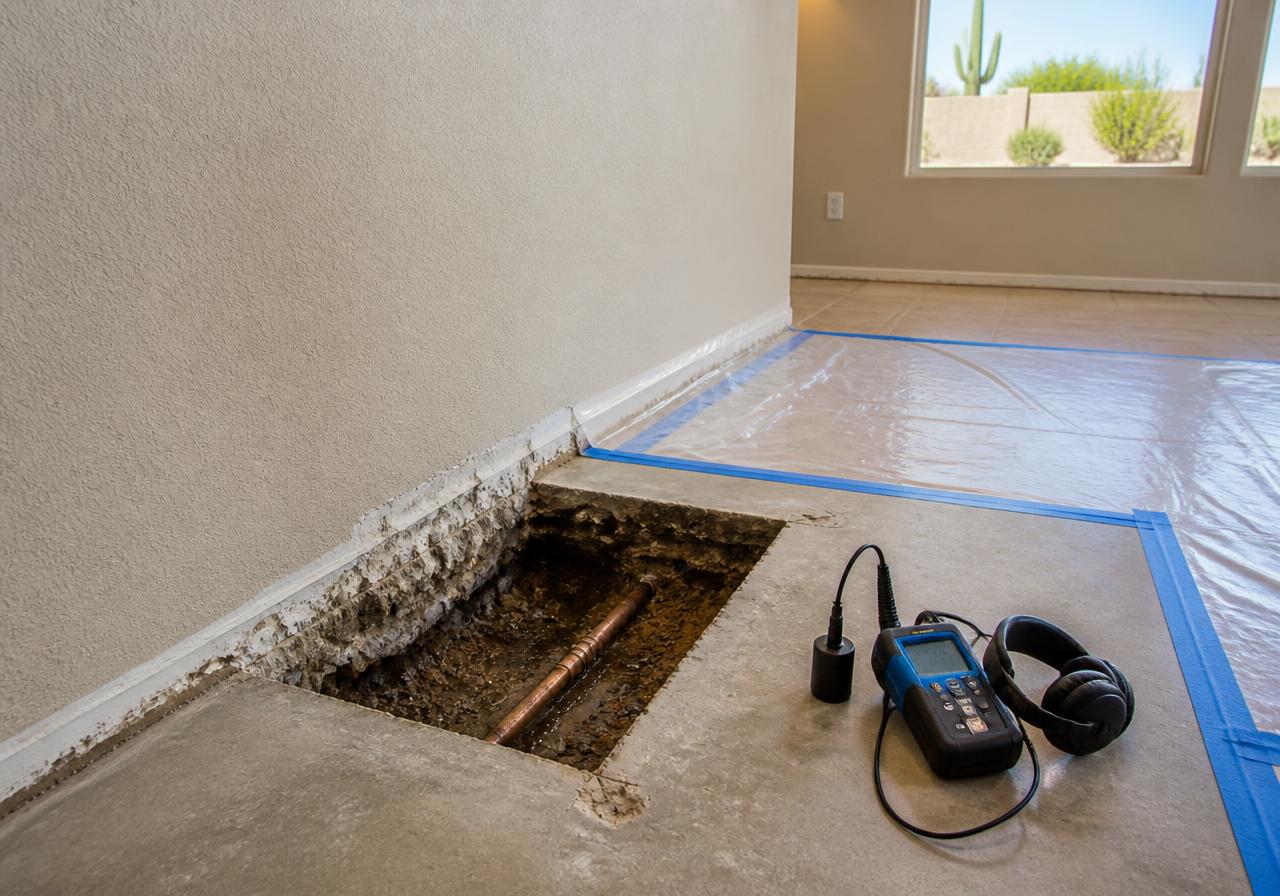
Water escaping a pressurized line under concrete makes a characteristic sound. Ground microphones and electronic amplification let a technician follow that signature across the floor and identify where it peaks. Slab thickness, flooring type, and background noise all affect what can be heard, which is why acoustic work follows pressure testing rather than replacing it.
- 3
Line tracing
Before anything is opened, the actual route of the pipe under the slab is traced and marked. Original plans are often wrong or unavailable, and cutting where the pipe is not is the most common way a repair gets expensive.
- 4
Thermal survey
On hot-water lines, temperature differences at the slab surface can support the acoustic findings and tighten the location.
- 5
Video pipe inspection
A camera is the right tool for drain and sewer lines, which are large enough and open enough to accept one. Central Mechanical includes video line scoping on most drain and sewer calls. A camera is not, however, how a pressurized under-slab supply leak gets located. Small-diameter pressurized copper or PEX carrying water under pressure is not a camera application, and any diagnosis of a supply leak should rest on pressure isolation and acoustic work instead.
The order matters: isolate, then listen, then trace, then mark. A location produced without pressure isolation is an opinion, not a finding.
Slab leak repair options
There is no default correct repair. The right approach depends on where the leak is, what the pipe is made of, how the house is finished above the slab, and whether this failure looks isolated or systemic. Below are the approaches that typically get considered.
Spot repair through the slab
- When considered
- a single, precisely located leak in an otherwise sound system, in a spot that can be reached.
- Advantages
- smallest scope of work, leaves the rest of the plumbing untouched, usually the least expensive path.
- Tradeoffs
- requires cutting and later patching concrete and whatever flooring sits on it, and does nothing for a system that is failing in more than one place.
- Disruption
- localized but real, including dust control and a floor patch.
- Decision factors
- accuracy of the leak location, flooring type above, and whether this is the first failure or the latest of several.
Reroute of the affected line
- When considered
- the leak is under finished space that is costly to open, the pipe run is short enough to bypass, or the location is impractical to reach.
- Advantages
- abandons the failed segment entirely instead of repairing pipe that is already in a bad environment, and avoids opening the slab at the leak.
- Tradeoffs
- new line must be routed through walls, ceilings, or attic space, which means drywall work and, in some cases, insulation considerations for exposed runs.
- Disruption
- moderate, spread across more of the house than a spot repair.
- Decision factors
- length of the run, available routing path, condition of the remaining line.
Overhead reroute
- When considered
- the practical version of a reroute in many single-story slab homes, running the new line up a wall, through the attic, and back down.
- Advantages
- takes the line out of the slab environment altogether and makes future repairs accessible rather than buried.
- Tradeoffs
- attic runs require correct support and protection, and the work touches multiple rooms.
- Disruption
- moderate, with drywall patching at entry and exit points.
- Decision factors
- attic access, house layout, number of fixtures served.
Partial repipe
- When considered
- one branch or one zone of the system shows deterioration while the rest is in good condition.
- Advantages
- addresses the failing section without the scope of a whole-house job.
- Tradeoffs
- leaves original pipe in service elsewhere, which may raise the same question again later.
- Disruption
- moderate to significant in the affected area.
- Decision factors
- condition assessment of the remaining system, age, and pipe material.
Whole-house repipe
- When considered
- repeat failures, widespread deterioration, or an aging system where continued spot repairs stop making financial sense.
- Advantages
- resolves the underlying condition rather than the current symptom, and typically relocates plumbing out of the slab.
- Tradeoffs
- largest scope, longest schedule, most restoration work.
- Disruption
- significant, planned in phases to keep water available.
- Decision factors
- number of prior leaks, system age and material, planned length of ownership, and what a professional condition assessment finds.
What affects slab leak repair cost
Published national averages for slab leak repair vary enormously and are not a useful prediction for a specific house, so this guide does not quote a number. What is genuinely useful is knowing which variables move the figure, because those are the things a good estimate will actually address.
Whether it is supply or drain
Different access requirements, different repair methods, different scope.
Location under the slab
A line near an exterior wall or an accessible edge is a different job than one under the center of a finished room.
What is on top of the concrete
Carpet lifts and relays. Tile, stone, polished concrete, and hardwood involve removal and restoration that can exceed the plumbing work itself.
Access and excavation
Depth of the line, slab thickness, presence of post-tension cabling or reinforcement, and how much concrete must be removed.
Repair approach
Spot repair, reroute, partial repipe, and full repipe are different orders of magnitude, and the recommendation should be justified rather than assumed.
Pipe material and system age
Material affects both the repair method and the assessment of what the rest of the system is likely to do.
Number of affected lines
One failure and three failures are different problems.
Extent of existing water damage
Wet flooring, saturated subfloor material, and affected drywall add remediation scope beyond the plumbing.
Permits and code requirements
Some scopes require permitting and inspection, which is part of doing the work correctly.
Central Mechanical provides free in-home estimates and upfront pricing on plumbing repairs and installs, and every scope is documented with photos and video on the invoice. Any specific figure for your property should come from an on-site assessment, not from an article.
Does homeowners insurance cover a slab leak?
Coverage varies by policy, by insurer, by the cause of the loss, and by the endorsements attached to a specific contract, so no honest general answer exists. What is worth understanding is that policies commonly treat several distinct pieces of a slab leak differently: the resulting water damage to the home and its contents, the access or tear-out work required to reach the pipe, and the repair or replacement of the failed pipe itself. Those three are not automatically handled the same way.
Causes matter too. Losses attributed to long-term seepage, gradual deterioration, or deferred maintenance are treated differently from sudden failures under many policies.
Read your own policy language and call your insurer or agent before work begins. Document what you find with photos and dates, keep the written diagnostic findings and scope from your plumbing contractor, and ask your carrier directly what it needs before repairs start. That conversation is the only reliable source of a claim-specific answer.
What to do if you suspect a slab leak
Work through these in order. The first three cost nothing and rule out the most common non-slab explanations.
- 1
Look before you conclude
Check under sinks, around the water heater, behind toilets, at the washing machine connections, and at the air conditioning condensate drain. Above-slab leaks are more common and much cheaper to fix.
- 2
Confirm nothing is running
Toilets, ice makers, water softener regeneration cycles, irrigation, pool fill valves, and evaporative coolers all consume water quietly.
- 3
Read the meter
With everything off, note the meter reading, wait 20 to 30 minutes without using water, and read it again. Movement means water is leaving the system somewhere.
- 4
Document what you see
Photograph damp areas, warm spots, damaged flooring, and meter readings with timestamps. This helps both the diagnosis and any insurance conversation.
- 5
Do not open the slab
Cutting concrete based on a guess about pipe location is how a moderate repair becomes an expensive one. Locating comes first, always.
- 6
Know when it is urgent
Active water spreading across flooring, a sudden pressure loss, or standing water calls for immediate attention. Central Mechanical runs 24/7 emergency plumbing dispatch across the Valley for exactly these situations.
- 7
Get it located properly
Schedule leak detection with a licensed plumbing contractor and ask specifically how the location will be confirmed before any concrete is touched.
Professional plumbing and leak detection in Phoenix
Central Mechanical Services LLC has served the Phoenix metro since 2019, backed by a team with more than 150 years of combined mechanical experience and a master plumber on staff leading every plumbing project. We are licensed under AZ ROC #325622 (CR-37 Plumbing) and AZ ROC #325571 (CR-39 HVAC and Refrigeration), hold a KB-1 Dual Building Contractor license, and are bonded and insured.
Our plumbing work covers leak detection, pinhole leak repair, copper, PEX, and galvanized repipes, water heater service and replacement, drain cleaning with video line scoping, fixture installation, and commercial plumbing, with 24/7 emergency dispatch across the Valley. Our process is the same on every call: diagnose the actual problem, show you the evidence in photos and video, do the work to code with permits where required, then verify and clean up.
If any of the signs in this guide describe what is happening in your home, request plumbing service or a free in-home estimate and we will start with a proper diagnosis. If you are also weighing an aging water heater, our guide to Phoenix water heater repair and replacement covers that decision separately.
Need a Phoenix tech today?
Talk to a real Valley dispatcher - same-day appointments and live answer 24/7.